
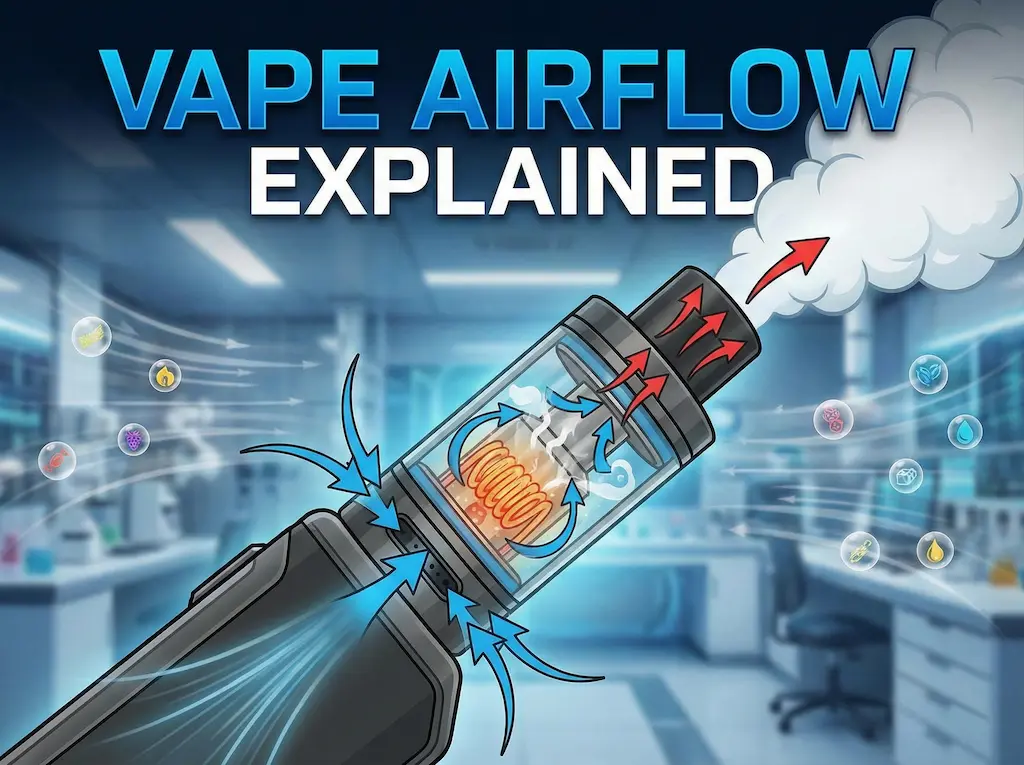
How Airflow Affects Flavor, Nicotine, and Your Vaping Experience
Vape airflow is one of the most misunderstood aspects of vaping. Many users focus on nicotine strength or flavor names but overlook airflow—even though it directly shapes how a vape feels, tastes, and performs. Airflow determines how much air mixes with vapor, how warm or cool each puff feels, and how concentrated the vapor is when it reaches your throat.
In this guide, we’ll clearly explain:
- What vape airflow is and how it works
- Whether high or low airflow is better for vaping
- What airflow should vape at
- Whether more airflow means more nicotine
By the end, you’ll understand how airflow influences your experience and how to choose the right airflow style for your needs.
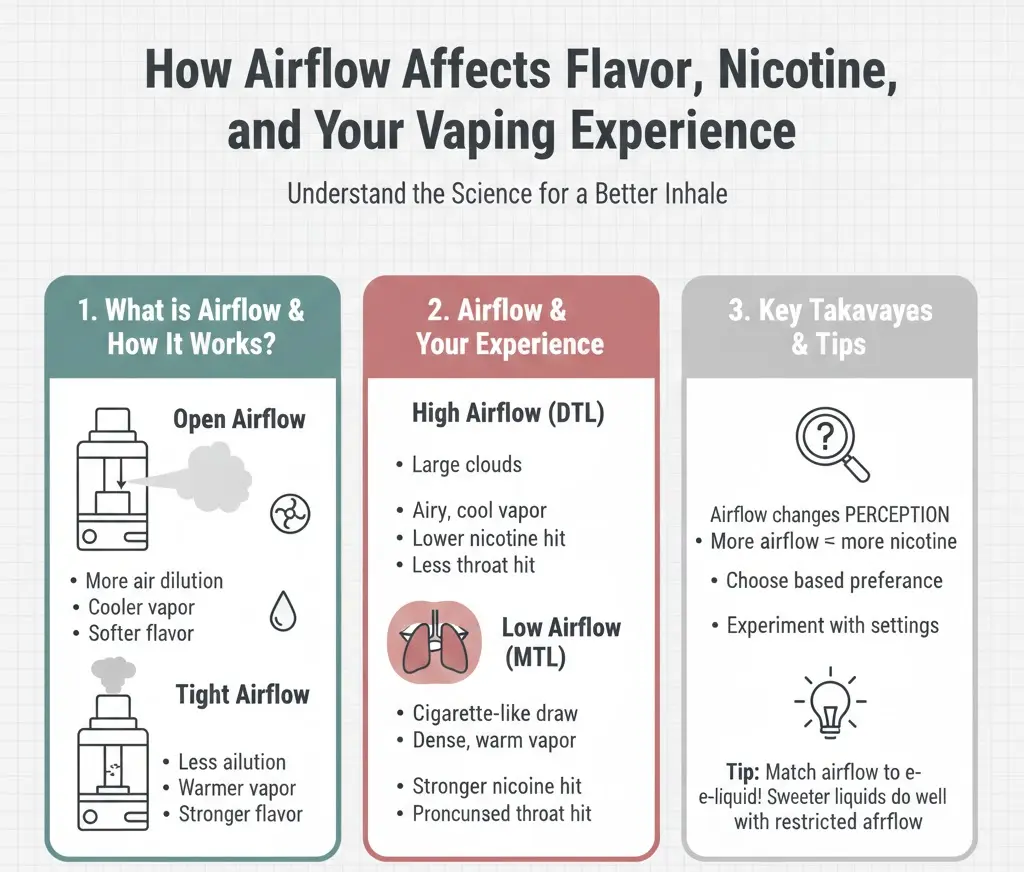
Key Takeaways – Vape Airflow Simplified
- Vape airflow controls how much air mixes with vapor
- Low airflow = stronger flavor and throat hit
- High airflow = smoother vapor and bigger clouds
- More airflow does not equal more nicotine
- Correct airflow depends on device type and nikotinstyrke
- Disposable vapes use fixed airflow to optimize consistency
What Is Vape Airflow?
Vape airflow refers to the amount of air that enters a vape device while you inhale. This air mixes with vapor produced by the heated e-liquid and carries it into your mouth and lungs.
Every vape device—whether disposable, pod system, or box mod—has airflow channels. These channels may be:
- Fixed (common in disposable vapes)
- Adjustable via airflow rings or sliders
- Designed internally without user control
Airflow is not just about how “easy” it is to inhale. It directly affects:
- Dampdensitet
- Smagsintensitet
- Slag i halsen
- Damptemperatur
- Perceived nicotine strength
How Vape Airflow Works Inside a Device
Think of a vape like a small “air-and-heat engine.” You inhale, air moves through the device, the coil heats liquid into aerosol, and that aerosol is carried to you. The key is that airflow is not only “how easy it is to pull”—it also determines how efficiently the coil can vaporize liquid and how concentrated each puff feels.
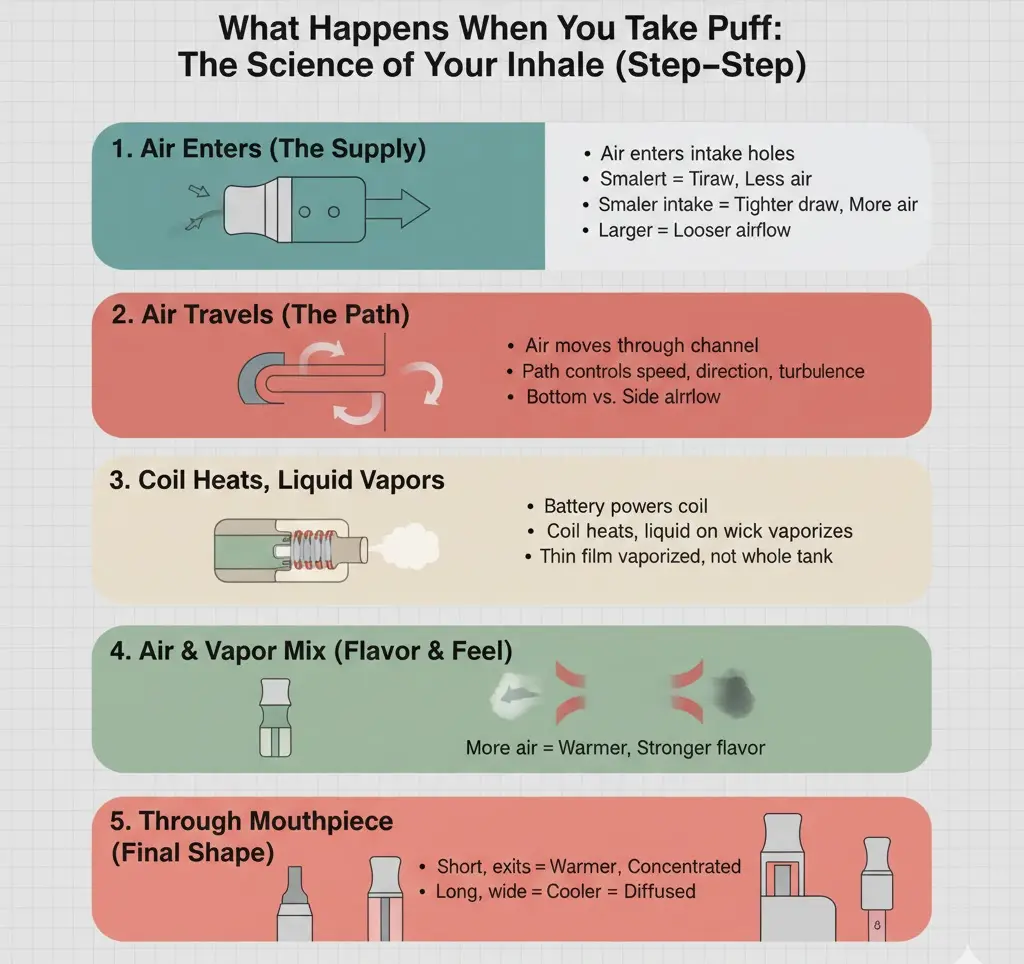
Hvad sker der, når du tager et pust (trin for trin)
1) Air enters through intake holes or slots
Every vape has one or more intake points—tiny holes on the base, side, or under the pod/tank. These holes act like the device’s “air supply.”
- Smaller intake / less open airflow → tighter draw, less total air
- Larger intake / more open airflow → looser draw, more total air
Why it matters: Intake size affects the amount of fresh air available to cool the coil and dilute the vapor.
2) Air travels through the airflow channel toward the coil area
After entering, air moves through an internal channel. In many devices, this channel is shaped to control:
- How fast does the air moves
- Where the air hits the coil
- How much turbulence (mixing) happens
Some devices direct air under the coil (bottom airflow), others direct it from the side (side airflow), and some use a more restricted path for a cigarette-like draw.
Why it matters: The airflow path influences vapor density, flavor clarity, and condensation buildup.
3) The coil heats up and vaporizes e-liquid at the wick surface
The coil is wrapped around or integrated with a wick (often cotton). The wick pulls e-liquid toward the coil through capillary action.
When you inhale:
- Batteriet sender strøm
- The coil heats quickly
- The liquid at the wick surface turns into aerosol (vapor)
Key concept: The coil does not “boil” the entire tank—only a thin film of liquid at the wick surface is vaporized.
4) Air and vapor mix (this is where “feel” and “taste” are shaped)
This mixing zone is where your experience is built.
- More airflow introduces more air volume into the mix → vapor is more diluted, usually cooler, and often feels smoother
- Less airflow introduces less air volume → vapor is more concentrated, warmer, and often has stronger flavor intensity per puff
But there’s another factor: airflow also affects coil temperature and stability.
5) The mixture travels through the chimney or mouthpiece
Finally, the air-vapor mixture moves through a central tube (chimney) and out the mouthpiece.
- A short, narrow chimney can keep the vapor warmer and more concentrated
- A longer or wider chimney can cool vapor and reduce intensity
- A narrow mouthpiece tends to concentrate the stream, boosting perceived flavor
Why it matters: Mouthpiece shape and chimney length can make two vapes with the same liquid feel very different.
Why the “Air-to-Vapor Ratio” Changes Everything
A simple way to understand airflow is to think of it like mixing juice with water:
- If you add more water (more air), the taste becomes lighter
- If you add less water (less air), the taste becomes stronger
In vaping terms:
- Åben luftstrøm often means less “punch” per puff, but a smoother inhale
- Begrænset luftstrøm often means more intensity, but a stronger throat sensation
How Airflow Interacts With Coil Temperature, Wick Saturation, and Power
Airflow cannot be separated from device design because it affects:
Coil temperature (heat control)
- More airflow cools the coil, which can prevent overheating at higher wattage
- Less airflow allows the coil to run hotter, which can intensify flavor but may become harsh if too hot
Wick saturation (liquid feeding)
- Tight airflow often encourages slower, smaller puffs. That can help the wick stay saturated.
- Very long puffs—especially with high power—can outpace the wick’s ability to feed liquid, leading to dryness or harshness.
Power output (wattage and efficiency)
- High-power setups usually require more airflow so the coil doesn’t overheat
- Low-power setups often perform best with restricted airflow to keep vapor concentrated
Tip: If your vape suddenly feels harsh, airflow may be too tight for your power level—or your coil may be heating faster than your wick can feed liquid.
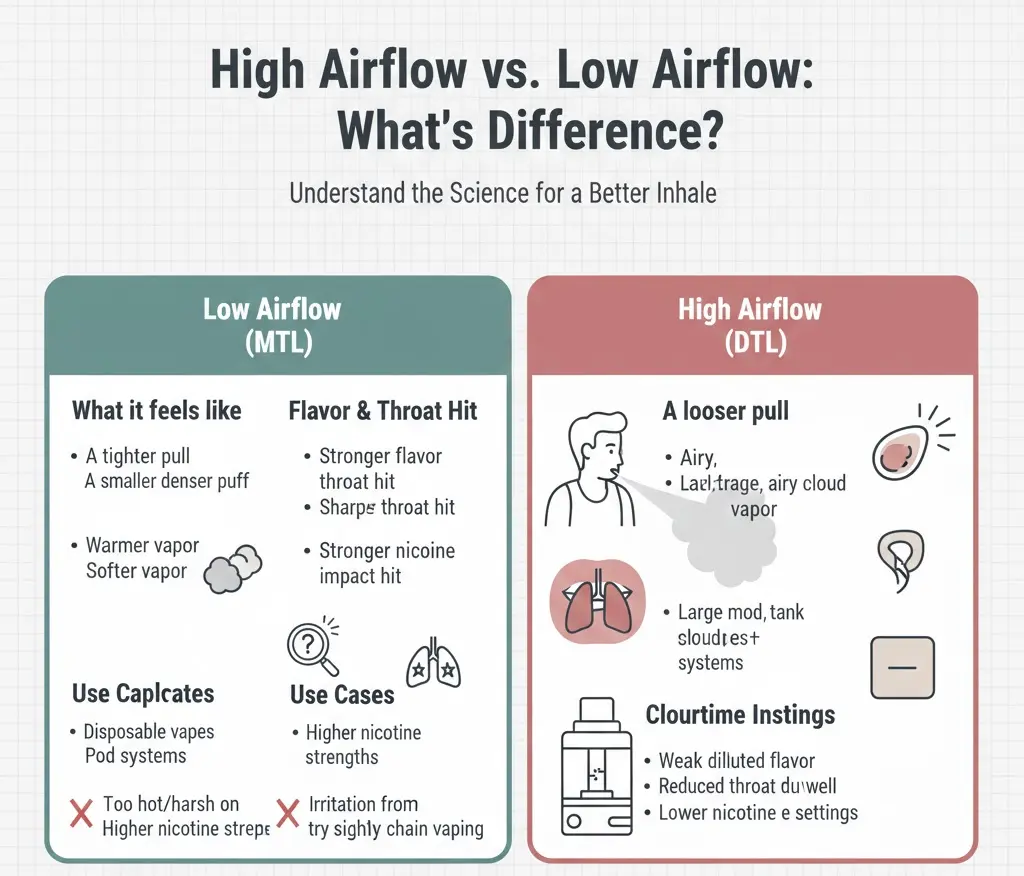
High Airflow vs Low Airflow – What’s the Difference? (Expanded)
Airflow is basically your “mixing control.” It changes vapor concentration, temperature, and how nicotine feels.
Low Airflow (Tight Draw / Restricted Airflow)
Low airflow means the device allows less air per puff, creating a tighter, more controlled inhale (often closer to cigarette-style).
What it feels like
- A tighter pull (more resistance)
- A smaller, denser puff
- Often warmer vapor
What it does to flavor
- Flavor feels stronger and more concentrated
- Subtle notes may appear clearer because the vapor isn’t heavily diluted
What does it do to throat hit
- The throat hit can feel sharper
- Nicotine “impact” may feel stronger per puff (because vapor is denser)
Typical use cases
- Disposable vapes (usually fixed airflow)
- Pod-systemer
- MTL (mouth-to-lung) style inhaling
- Higher nicotine strengths/Nikotinsalte
Common mistakes
- Making airflow too tight on a higher-power device → can feel overly hot or harsh
- Chain vaping with tight airflow → can increase warmth and irritation
Tip: If flavor is strong but your throat feels irritated, slightly open airflow (or shorten your puffs) can improve comfort without killing flavor.
High Airflow (Open Draw)
High airflow means the device allows more air per puff, creating a looser inhale with less resistance.
What it feels like
- Easier pull
- Bigger airflow volume
- Often cooler vapor
What it does to vapor and clouds
- More airflow generally creates larger clouds because the coil has more fresh air passing through (especially at higher power)
What it does to flavor
- Flavor can feel lighter because vapor is more diluted
- Some flavors (especially sweet or creamy ones) may taste smoother, while sharp flavors can feel less intense
What does it do to throat hit
- The throat hit often becomes softer
- Nicotine can feel less “punchy” per puff (not less nicotine content—just less concentration per inhale)
Typical use cases
- Sub-ohm tanks
- Box mods
- DTL (direct-to-lung) vaping
- Lower nicotine strengths
Common mistakes
- Opening airflow too much on low-power devices → vapor becomes airy and unsatisfying
- Pairing high airflow with high nicotine → can increase total intake because it’s easy to take long puffs
Tip: If your vape feels “too airy” and flavor seems weak, reduce airflow slightly before changing liquid or coil—airflow is often the real cause.
Is High or Low Airflow Better for Vaping?
There is no universally “better” airflow setting. The best airflow depends on how and why you vape.
Low airflow is generally better if you:
- Prefer strong flavor
- Use higher nicotine
- Want a cigarette-like draw
- Use disposable or pod devices
High airflow is generally better if you:
- Prefer smooth, cool vapor
- Enjoy larger clouds
- Use lower nicotine levels
- Vape directly into the lungs
The key point: airflow should match your device and nicotine strength, not fight against them.
What Airflow Should I Vape At?
If your device allows airflow adjustment, start in the middle and adjust gradually.
General Guidelines
For beginners
- Start with slightly restricted airflow
- Focus on comfort and flavor clarity
For disposable vapes
- Airflow is usually fixed
- Designed for restricted, flavor-focused draws
For pod systems
- Slightly tight airflow works best
- Avoid fully open airflow unless using very low nicotine
For advanced devices
- Adjust airflow based on coil type and power
- Higher wattage usually needs more airflow to avoid overheating
Listen to your body. If vapor feels harsh, dry, or uncomfortable, airflow may be too tight. If flavor feels weak or airy, airflow may be too open.
Does More Airflow Mean More Nicotine?
Det er en almindelig misforståelse. More airflow does not mean more nicotine.
Nicotine intake depends on:
- Nicotine concentration in the liquid
- Puffets varighed
- Puff frequency
- Dampdensitet
With higher airflow:
- Each puff contains more air
- Vapor is more diluted
- Nicotine per puff may actually feel weaker
With lower airflow:
- Vapor is more concentrated
- Levering af nikotin can feel stronger per puff
This is why tight airflow devices often use higher nicotine strengths without feeling overwhelming.
How Airflow Affects Flavor and Throat Hit
Airflow plays a major role in how flavor and throat sensation are perceived.
- Tight airflow concentrates vapor, making flavors feel bolder and more defined
- Open airflow spreads vapor across more air, softening flavor intensity
- The throat hit becomes sharper with restricted airflow
- Throat hit feels smoother with open airflow
If a vape tastes dull or weak, airflow is often the first thing to check.
Common Airflow Mistakes (And How to Fix Them)
Airflow too open
- Symptom: weak flavor, airy hits
- Fix: Close the airflow slightly
Airflow too tight
- Symptom: harsh or hot vapor
- Fix: Open airflow gradually
Mismatch with nicotine strength
- High nicotine + open airflow may feel unsatisfying
- Low nicotine + tight airflow may feel harsh
Ignoring airflow entirely
- Many users adjust power but forget airflow
- Always balance airflow with wattage and nicotine
Disposable Vapes and Fixed Airflow Design
Engangs-dampere typically use fixed airflow, meaning the user cannot adjust it. This is intentional.
Fixed airflow allows manufacturers to:
- Optimize flavor delivery
- Match coil resistance and power precisely
- Prevent user error
- Create consistent performance
Most disposable vapes use restricted airflow because it:
- Enhances flavor
- Works well with nicotine salts
- Feels intuitive for beginners
This is one reason disposable vapes often feel more “dialed in” right out of the box.
FAQ – Vape Airflow Questions
Is high or low airflow better for vaping?
Neither is universally better. It depends on your device, nicotine level, and preferred inhale style.
What airflow should I vape at?
Start with moderate restriction and adjust based on comfort and flavor.
Does more airflow mean more nicotine?
No. More airflow dilutes vapor and often makes nicotine feel weaker per puff.
Why does my vape taste weak when the airflow is open?
Too much air can dilute vapor, reducing flavor intensity.
Se mere
Hvad er MTL-dampning? En klar, begyndervenlig guide til mund-til-lunge-dampning
Hvad er RDL-dampning? En klar begynderguide til Restricted Direct Lung Vaping