
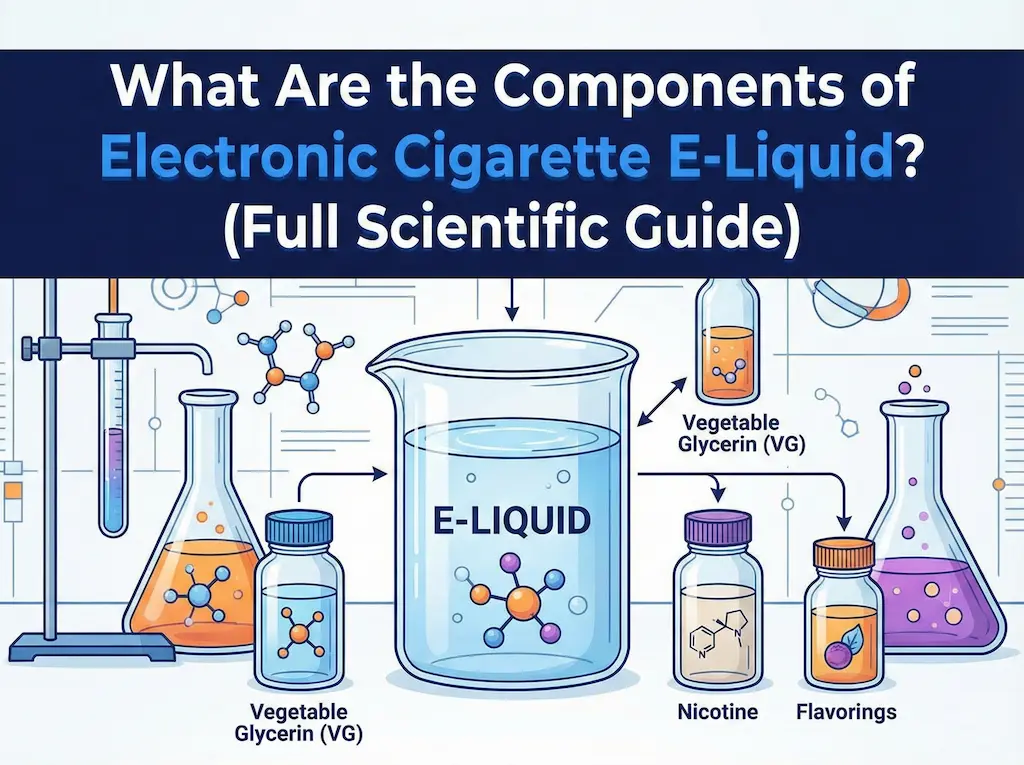
L'e-liquide, également connu sous le nom de jus de vape, est le matériau de base de chaque cigarette électronique. Il peut paraître simple, mais sa formulation repose sur la chimie, la science de l'inhalation et des décennies de recherche sur les ingrédients de qualité alimentaire.
Pour les nouveaux vapoteurs, les personnes en transition vers le tabagisme ou toute personne curieuse de connaître la technologie du vapotage, l'une des questions les plus fréquentes est la suivante :
"Qu'y a-t-il exactement dans un e-liquide ?
"Pourquoi ces ingrédients sont-ils utilisés et comment agissent-ils ?
Voici le réponse courte:
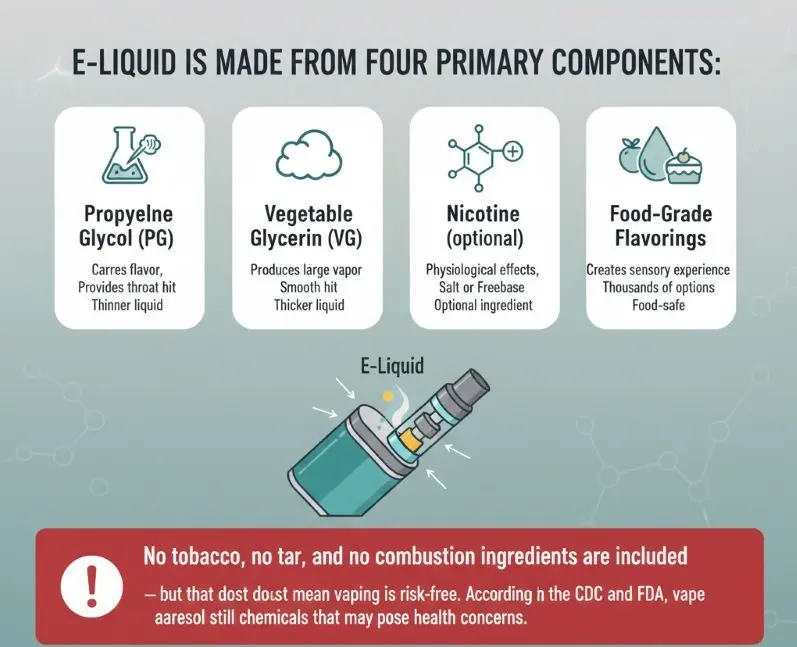
L'e-liquide est composé de quatre éléments principaux :
- Propylène glycol (PG)
- Glycérine végétale (VG)
- Nicotine (facultatif)
- Arômes de qualité alimentaire
Chaque ingrédient a une fonction scientifique spécifique-Le GPL véhicule la saveur, le VG crée la vapeur, la nicotine procure des effets physiologiques et les arômes créent une expérience sensorielle. Il n'y a ni tabac, ni goudron, ni ingrédients de combustion, mais cela ne signifie pas que le vapotage est sans risque. Selon le CDC et la FDA, les aérosols de vapotage contiennent encore des produits chimiques qui peuvent poser des problèmes de santé.
Ce guide explique pourquoi ces ingrédients sont utilisés, comment ils agissent dans une vape et ce qui différencie l'e-liquide de la fumée de cigarette.
Pourquoi il est important de comprendre les ingrédients des e-liquides
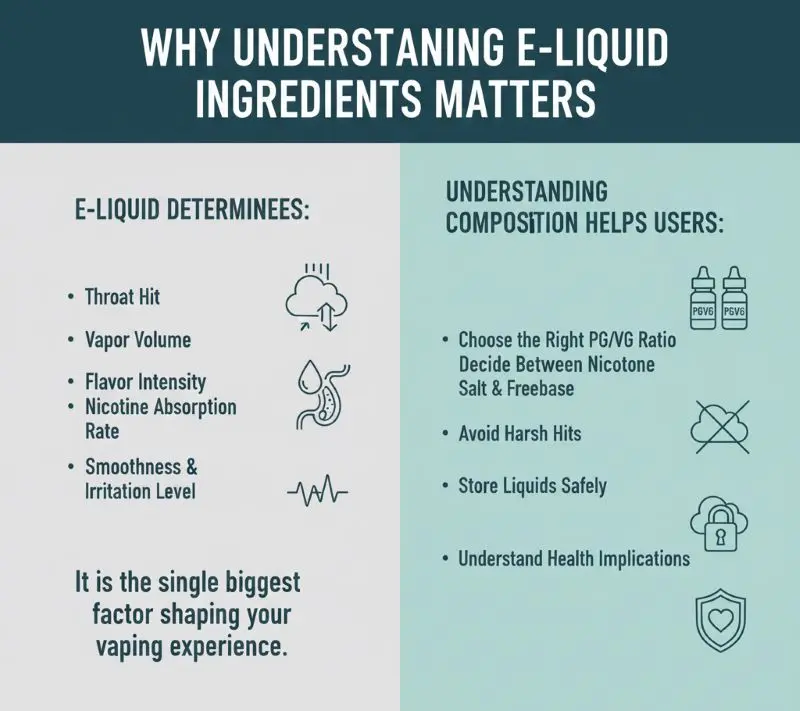
L'e-liquide détermine :
- Coup à la gorge
- Volume de vapeur
- Intensité de la saveur
- Taux d'absorption de la nicotine
- Douceur et niveau d'irritation
C'est le facteur le plus important qui détermine votre expérience de vapotage.
La compréhension de la composition aide également les utilisateurs :
- Choisir le bon rapport PG/VG
- Choisir entre le sel de nicotine et le freebase
- Éviter les coups durs
- Stocker les liquides en toute sécurité
- Comprendre les implications pour la santé
Les quatre principaux composants de l'e-liquide (expliqués scientifiquement)
Voici un aperçu plus approfondi de chaque ingrédient...non seulement "ce qu'il est", mais aussi pourquoi il existe et comment il se comporte lorsqu'il est chauffé.
1. Propylène glycol (PG)
Le PG est un liquide fin, incolore et de faible viscosité, largement utilisé dans les :
- Inhalateurs pour l'asthme
- Nébuliseurs médicaux
- Supports d'arômes alimentaires
- Produits pharmaceutiques
Pourquoi le PG est-il utilisé dans les e-liquides ?
- Excellent pour transporter les molécules d'arôme
- Effet de gorge intense semblable à celui de la fumée de cigarette
- Aide à prévenir l'inondation de la bobine en raison de sa consistance fine
Comment le PG se comporte lorsqu'il est chauffé
Le PG se vaporise rapidement à des températures plus basses, ce qui produit :
- Une vapeur légère et vive
- Un goût prononcé
- Un "coup" perceptible dans la gorge
C'est la raison pour laquelle les liquides à fort taux de PG se rapprochent de la cigarette.
Notes de sécurité
La FDA classe le PG comme "généralement reconnu comme sûr" pour l'ingestion. Cependant, le CDC indique que les effets à long terme de l'inhalation doivent faire l'objet de recherches plus approfondies.
2. Glycérine végétale (VG)
Le VG est un liquide plus épais et plus doux dérivé d'huiles végétales.
Pourquoi le VG est-il utilisé dans les e-liquides ?
- Produit une vapeur dense et douce
- Crée une inhalation douce et légère
- Ajoute une légère douceur à la saveur
- Indispensable pour les dispositifs à haute teneur en vapeur
Comment le VG se comporte lorsqu'il est chauffé
Le VG nécessite une température plus élevée pour se vaporiser, ce qui produit :
- Gros nuages épais
- Inhalation en douceur
- Saveur douce et ronde
C'est pourquoi les vapoteurs sub-ohm utilisent des mélanges à haute teneur en alcool.
Propriétés chimiques
- Viscosité élevée
- Hygroscopique (absorbe l'humidité)
- Crée des gouttelettes d'aérosol lisses
3. Nicotine (facultatif, mais essentiel pour les fumeurs en transition)
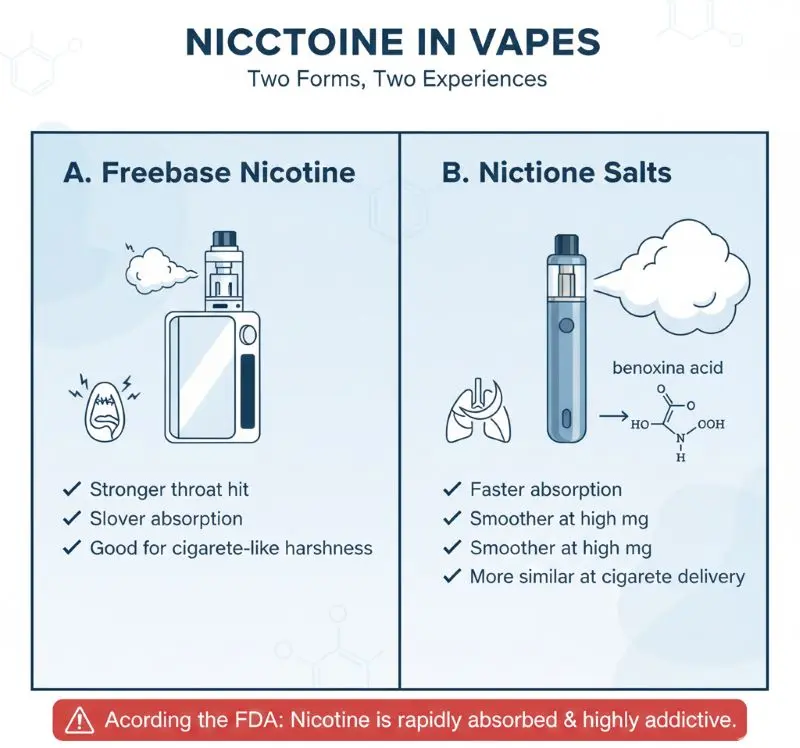
La nicotine contenue dans les e-liquides est purifiée et combinée à du PG/VG. Il existe deux formesChacun se comporte différemment dans l'organisme.
A. Nicotine libre
- Effet de gorge plus fort
- Absorption plus lente
- Commun dans les liquides de vape traditionnels
Bon pour les utilisateurs qui préfèrent une âpreté semblable à celle d'une cigarette.
B. Sels de nicotine
Créé en combinant la nicotine avec des acides organiques (par exemple, l'acide benzoïque).
Cela modifie le niveau de pH de la nicotine → inhalation plus douce à des concentrations plus élevées.
Pourquoi le sel de nicotine existe-t-il ?
- Une absorption plus rapide
- Plus souple à haute teneur en mg
- Plus similaire à comment les cigarettes délivrent de la nicotine
Selon la FDALa nicotine pénètre rapidement dans la circulation sanguine et crée une forte dépendance.
4. Arômes
Les arômes sont de qualité alimentaire composés couramment utilisés dans les boissons, les bonbons, les sauces et les produits de boulangerie.
Pourquoi les arômes sont-ils utilisés ?
- Donner du goût et de l'arôme
- Améliorer la satisfaction du vapotage
- Aider les fumeurs à faire la transition en leur proposant d'autres saveurs.
Les saveurs varient selon les catégories :
- Fruits
- Menthol / Menthe
- Tabac
- Dessert
- Bonbons
- Boissons
Ces composés se vaporisent facilement en raison de leur structure moléculaire.
Notes de sécurité
Ils sont sans danger pour mangermais la sécurité de l'inhalation est encore à l'étude. C'est pourquoi la FDA et le CDC ne considèrent pas le vapotage comme inoffensif.
Ingrédients supplémentaires parfois présents dans les e-liquides
Édulcorants
Ajoutez du sucre ; il peut caraméliser les spires plus rapidement.
Agents réfrigérants (WS-23, Menthol)
Procure une sensation glacée sans arôme de menthe.
Acides (dans les liquides salins Nic)
L'acide benzoïque ou lactique adoucit la nicotine.
Petites quantités d'alcool ou d'eau distillée
Améliorer la diffusion des arômes ou diluer le liquide.
Ce que fait l'e-liquide Non Contenir
Le e-liquide contient sans feuille de tabac, sans goudron et sans monoxyde de carbone parce qu'il est chauffé et non brûlé.
La fumée de cigarette contient plus de 7 000 substances chimiques formées lors de la combustion.
L'aérosol de vaporisation contient :
- Gouttelettes de PG/VG
- Nicotine
- Particules chimiques aromatiques
Mais pas de substances cancérigènes issues de la combustion, comme le goudron.
Comment fonctionne l'e-liquide à l'intérieur d'un vaporisateur ?
Étape 1 - Absorption de la mèche
Le coton absorbe le liquide et l'achemine vers la bobine.
Étape 2 - Chauffage du serpentin
Batterie → bobine → chauffage rapide (200-250°C).
Étape 3 - Formation de vapeur
Le liquide se transforme en gouttelettes d'aérosol.
Étape 4 - Inhalation
La vapeur transporte la nicotine et l'arôme dans les poumons.
Rapport PG/VG : Pourquoi c'est important
| Ratio | Effet | Meilleur pour |
| 70 PG / 30 VG | Saveur forte, effet de gorge prononcé, petite vapeur | Fumeurs en transition |
| 50 PG / 50 VG | Saveur et vapeur équilibrées | Systèmes de pods |
| 70 VG / 30 PG | Inhalation douce, gros nuages | Vapoteurs sub-ohm |
Le mélange PG/VG détermine :
- Dureté
- Densité de vapeur
- Perception des arômes
- Compatibilité des appareils
Les ingrédients des e-liquides sont-ils sûrs ?
Selon le CDC :
L'aérosol de vaporisation contient moins de substances chimiques nocives que la fumée de cigarette, mais il est pas inoffensif.
Selon la FDA :
Les liquides des e-cigarettes contiennent des substances chimiques qui peuvent présenter des risques, notamment en raison du caractère addictif de la nicotine.
L'e-liquide est conçu pour être inhalé, mais il n'en est pas de même pour l'e-liquide. les effets à long terme sur la santé font encore l'objet de recherches.
Meilleur type d'e-liquide pour les fumeurs en transition
50/50 PG/VG
Sels de nicotine
Arômes de tabac ou de menthol
Systèmes à dosettes (tirage MTL serré)
Cette combinaison est celle qui reproduit le mieux le comportement de l'inhalation d'une cigarette.
SnagVape: Marque suggérée pour les e-liquides Smooth Nic Salt
Si vous découvrez la composition des e-liquides parce que vous êtes en train de passer du tabac à la cigarette, SnagVape propose des produits jetables inspirés du tabac qui utilisent des sels de nicotine doux et des mélanges PG/VG cohérents. Leurs dispositifs sont conçus pour fournir :
- Production de vapeur stable
- Effet de gorge satisfaisant
- Profils familiers de type tabac
- Conception pratique, pré-remplie
FAQ - Ingrédients des e-liquides
1. Quels sont les quatre principaux ingrédients du e-liquide ?
PG, VG, nicotine (facultatif) et arômes.
2. Que fait PG ?
Transporte les arômes, augmente l'effet de gorge, rend la vapeur plus fine.
3. Que fait VG ?
Crée des nuages de vapeur épais et une inhalation douce.
4. Tous les e-liquides contiennent-ils de la nicotine ?
Non. 0 mg options existent.
5. Qu'est-ce que le sel de nicotine ?
Une forme de nicotine plus douce et plus rapidement absorbée, fabriquée à partir d'acides.
6. Les arômes de qualité alimentaire peuvent-ils être inhalés sans danger ?
L'ingestion est sans danger, mais la sécurité de l'inhalation fait encore l'objet de recherches.
Vous pouvez lire la suite
Le vapotage peut-il causer des maux de dos ? Un guide clair et simple
Le vapotage provoque-t-il des saignements de nez ? Un guide clair et simple