
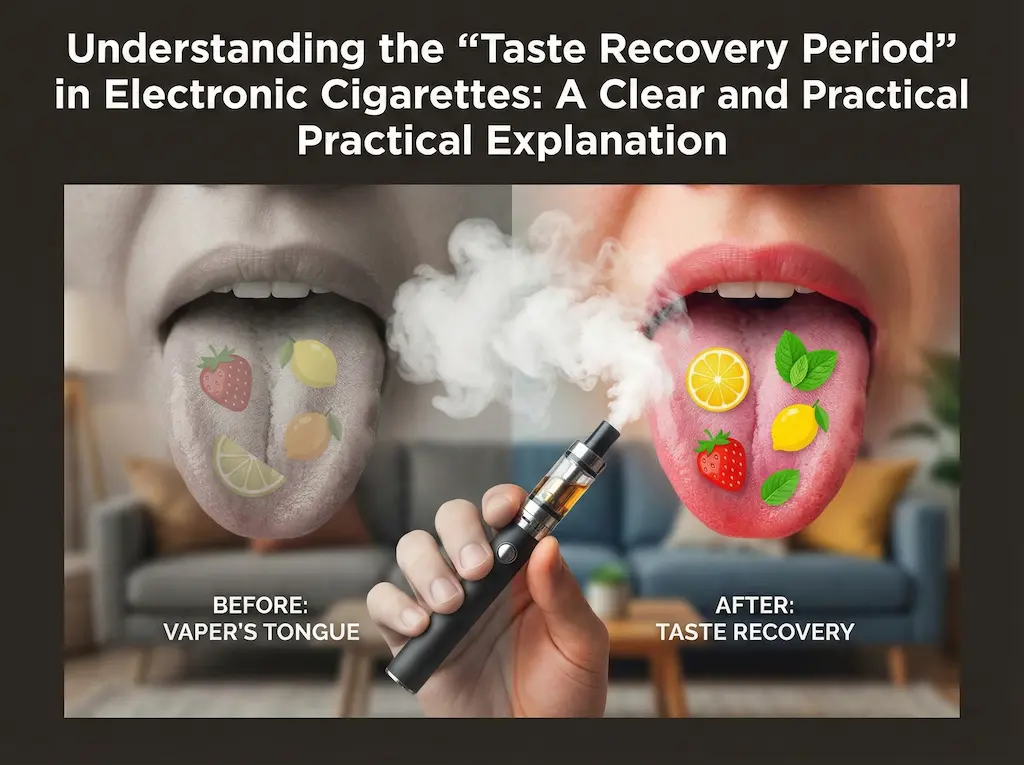
Lorsque l'on utilise une nouvelle cigarette électronique ou que l'on remplace le noyau de l'atomiseur (bobine), on remarque souvent que les premières bouffées n'ont pas le goût riche ou doux que l'on attendait. Ce premier stade est connu sous le nom de "période de récupération du goût".
Bien qu'il puisse sembler être un petit détail, il reflète un processus interne important au sein du système d'atomisation. Comprendre comment cette période se forme aide les utilisateurs, les évaluateurs et les fabricants à mieux évaluer les performances des bobines.
1. Qu'est-ce que la période de récupération du goût ?
La période de récupération du goût est la courte phase pendant laquelle un coil tout neuf n'a pas encore atteint ses meilleures performances gustatives.
Pendant cette période, la vapeur peut avoir un goût :
- Lumière
- Légèrement rugueux
- Incohérent
Il ne s'agit pas d'un dysfonctionnement. Il s'agit simplement d'une bobine qui atteint son état de fonctionnement prévu.
Conseil : Si la saveur précoce semble faible, cela signifie souvent que le système a n'a pas encore atteint la pleine saturation ou l'équilibre thermique. Il s'agit d'un comportement attendu.

2. Pourquoi la période de récupération du goût se forme-t-elle ?
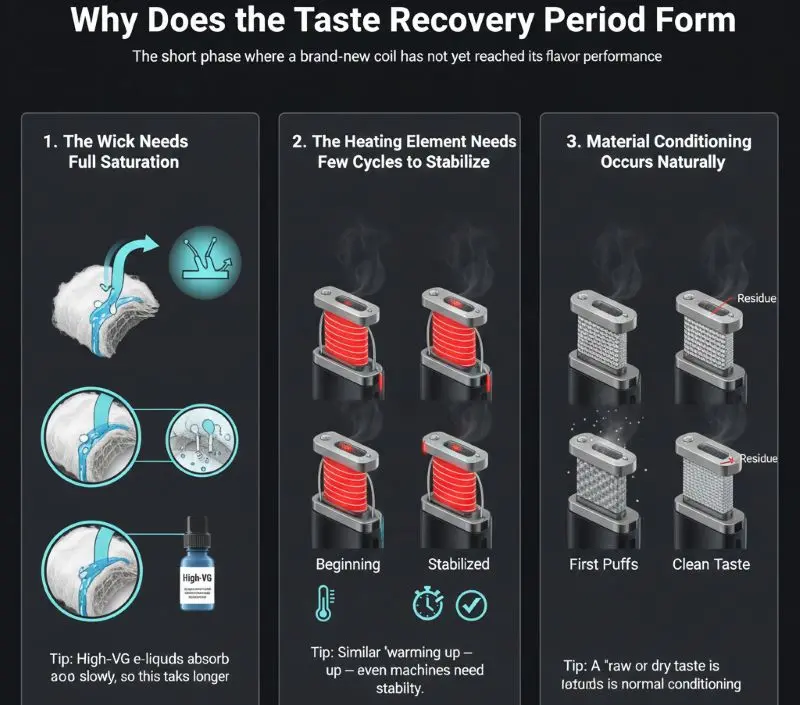
La formation de cette période est principalement due à trois mécanismes simples mais importants :
1. La mèche doit être complètement saturée
Tous les coils contiennent une mèche (coton ou céramique). Lorsque le coil est neuf, cette mèche est complètement sèche.
Cela prend du temps :
- liquide pour atteindre le centre
- les fibres internes se développent pleinement
- L'ensemble de la mèche doit commencer à être alimentée en liquide de manière régulière.
Sans saturation complète, la saveur ne peut être pleinement exprimée.
Conseil : Les e-liquides à forte teneur en alcool sont absorbés plus lentement, de sorte que la période de récupération du goût est naturellement plus longue.
2. L'élément chauffant a besoin de quelques cycles pour se stabiliser
Les fils ou mailles chauffants n'atteignent pas immédiatement une température uniforme.
Au début, les différentes zones peuvent chauffer de manière inégale, ce qui entraîne une production d'arômes instable.
Une fois la chaleur uniformément répartie, la vaporisation se fait en douceur et la saveur s'améliore considérablement.
Conseil : Cette étape s'apparente à un "échauffement" : même les machines ont besoin d'un point de départ stable.
3. Le conditionnement des matériaux se produit naturellement
Les bobines neuves peuvent contenir des résidus microscopiques provenant de la fabrication.
Au cours des premières activations, ces résidus brûlent ou se stabilisent.
Ensuite, le goût devient nettement plus propre.
Conseil : Un goût très "cru" ou "sec" lors des premières bouffées provient souvent de ce processus normal de conditionnement.
3. Combien de temps dure la période de récupération du goût ?
Des structures de bobines différentes nécessitent des temps de stabilisation différents :
- Bobines de maille : 2-10 bouffées
- Bobines de coton : 5-20 bouffées
- Bobines en céramique : 10-30 bouffées
La durée réelle dépend de
- épaisseur de l'e-liquide
- matériau de la mèche
- réglages de puissance
- conception du flux d'air
4. Toutes les cigarettes électroniques ont-elles une période de récupération du goût ? (Version tableau)
Vous trouverez ci-dessous une comparaison claire des différents types d'appareils et de leur période de récupération du goût.
Tableau : Comportement de récupération du goût avec différents types d'atomiseurs
| Type d'appareil / de bobine | La récupération du goût se produit-elle ? | Pourquoi cela se produit-il / Dans quelle mesure cela est-il perceptible ? |
| Dispositifs à bobine en maille | Oui, mais très court | La maille chauffe uniformément et sature rapidement ; l'arôme se stabilise après quelques bouffées. |
| Dispositifs à bobine de fil de coton | Oui, modérément | Le coton a besoin de temps pour absorber complètement le liquide ; la chaleur se stabilise lentement. |
| Dispositifs à bobine céramique | Oui, durée la plus longue | Le liquide se diffuse lentement à travers les micropores de la céramique ; il est très stable après récupération. |
| Systèmes de pods (bobines pré-amorcées) | Oui, mais de façon minimale | Les gousses sont souvent pré-saturées à l'usine, de sorte que la saveur se stabilise rapidement. |
| Vapes jetables de haute qualité | Oui, mais à peine perceptible | De nombreux produits jetables subissent un pré-conditionnement ; les utilisateurs ont souvent l'impression que l'arôme est stable dès le départ. |
| Bobines de mauvaise qualité ou mal conçues | Oui, peut être incohérent | Une densité de coton inégale, une mauvaise circulation de l'air ou des matériaux de mauvaise qualité accentuent la récupération. |
Conseil : Plus l'ingénierie est avancée (précision des mailles, préamorçage, géométrie du flux d'air), plus la période de récupération du goût est courte et douce.
5. Que se passe-t-il après la fin de la période de récupération ?
Une fois que la mèche est saturée et que la distribution de la chaleur se stabilise :
- la saveur devient plus prononcée
- la vapeur devient plus fluide
- la température devient constante
- L'appareil fonctionne comme prévu
En termes simples, le La bobine fonctionne maintenant dans des conditions idéales.
Conseil : Une bobine qui jamais se stabilise indique généralement des problèmes structurels (mauvais conditionnement du coton, déséquilibre des flux d'air ou qualité inégale des mailles).
6. Conclusion
La période de récupération du goût fait partie intégrante du fonctionnement des bobines d'atomiseur.
Il se forme parce que :
- La mèche doit absorber le liquide
- L'élément chauffant a besoin de plusieurs cycles pour se stabiliser
- Les matériaux subissent un conditionnement naturel
Tous les types d'atomiseurs connaissent cette période, mais sa durée varie en fonction de la conception et de la qualité de fabrication. Les mesh coils se rétablissent le plus rapidement, les coils en céramique prennent le plus de temps, et les jetables pré-conditionnés peuvent occulter complètement le processus.
La compréhension de cette phase permet aux utilisateurs et aux fabricants d'évaluer plus précisément les performances des serpentins et d'apprécier l'ingénierie qui sous-tend la technologie moderne du vapotage.
FAQ : Période de récupération du goût dans les cigarettes électroniques
1. Pourquoi un nouvelle bobine produisent souvent une saveur atténuée ou peu claire ?
Comme la mèche et l'élément chauffant n'ont pas encore atteint l'équilibre opérationnel, les fibres de coton ont besoin de temps pour se dilater et absorber le liquide, les micropores en céramique doivent être saturés et les fils chauffants doivent stabiliser leur résistance. Ce comportement transitoire est attendu dans tous les systèmes d'atomisation.
2. La période de récupération du goût indique-t-elle un défaut de la bobine ?
Non. La période de récupération du goût est une phase standard de conditionnement du matériel. Tous les coils - coton, mesh, céramique et quartz - ont besoin d'un court temps de stabilisation avant de délivrer une saveur précise et constante.
3. Quel type de bobine a la période de récupération du goût la plus rapide ?
Les serpentins en maille se stabilisent le plus rapidement en raison de leur surface de chauffe uniforme et de leur efficacité de saturation élevée. Le coton est modéré. La céramique est la plus longue en raison de sa dynamique d'absorption micro-poreuse.
4. Un mauvais réglage des watts peut-il affecter le processus de récupération du goût ?
Oui. Une puissance excessive au début de l'activation du coil peut brûler le coton ou surcharger les surfaces en céramique, ce qui réduit la durée de vie du coil et altère les arômes. Un cycle thermique contrôlé à faible puissance permet d'optimiser les performances à long terme.
5. Comment la viscosité de l'e-liquide influence-t-elle la récupération du goût ?
Les formulations épaisses ou à forte teneur en gaz saturent le coton plus lentement que les liquides minces. Les serpentins en céramique ont également besoin de plus de temps pour absorber complètement les liquides visqueux. Cela peut prolonger la période de récupération du goût, mais améliore en fin de compte les performances.
6. La période de récupération du goût est-elle plus courte dans les serpentins pré-conditionnés ou pré-amorcés ?
Oui. Les usines qui effectuent un pré-conditionnement thermique, un pré-mouillage de la mèche ou un étalonnage de la résistance pendant le contrôle de qualité réduisent considérablement la durée de récupération du goût. Ces pratiques d'ingénierie sont en corrélation directe avec un meilleur goût initial.
7. La période de récupération du goût a-t-elle un impact sur la sécurité ?
Indirectement, oui. Permettre au serpentin de se stabiliser permet d'éviter les brûlures sèches, les mèches roussies et la formation prématurée de carbone. L'achèvement de cette phase garantit que le serpentin fonctionne dans des paramètres thermiques sûrs.
Vous pouvez lire la suite
Quels sont les composants du liquide pour cigarette électronique (guide scientifique complet) ?
Pourquoi les cigarettes électroniques ont-elles une odeur plus faible que les cigarettes ?
Cigarettes électroniques jetables et cigarettes électroniques rechargeables