
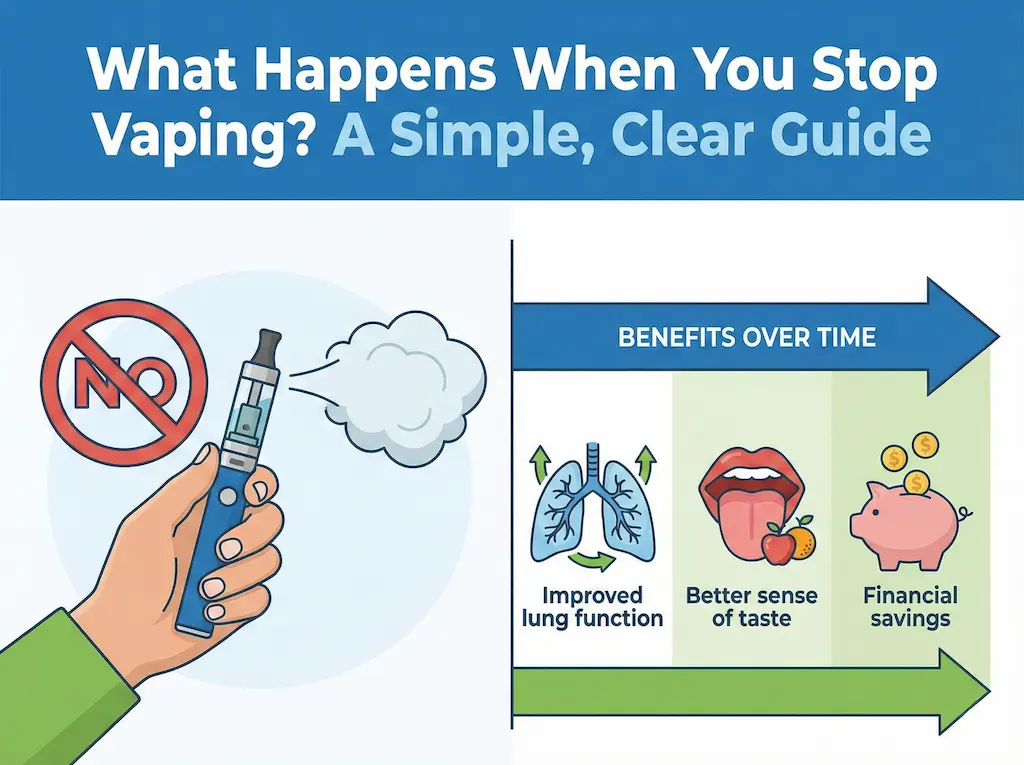
Att sluta vaping kan förändra din kropp snabbt.
Vissa förändringar känns bra. Vissa känns obekväma i några dagar.
Denna guide förklarar vad som verkligen händer när du slutar vampavarför det händer och hur man kan göra processen enklare.
Vad händer med din kropp när du slutar vaping?
När du slutar vaping börjar din kropp anpassa sig till lägre nikotinnivåer.
Nikotin lämnar ditt system snabbt, så du kan känna förändringar inom timmar.
Så här går det normalt till:
1. Nikotinnivåerna sjunker
Nikotin börjar lämna ditt blod inom 1-3 timmar.
Hjärnan märker av nedgången snabbt, vilket är anledningen till att det tidiga suget är starkt.
2. Du kan känna abstinens
Abstinensbesvär är normalt.
Det händer eftersom din hjärna är van vid nikotin.
Vanliga symtom på nikotinabstinens är bl.a:
- irritabilitet
- ångest
- huvudvärk
- hosta
- problem med att fokusera
- rastlöshet
- starkare sug efter mat
Dessa symtom kulminerar under den första 2-3 dagar.
3. Dina lungor börjar rensas
Vaping minskar lungornas naturliga reningsförmåga.
När du slutar börjar dina lungor reparera sig.
Du kanske hostar mer i början - det är normalt eftersom bröstkorgen rensar bort ångor som fastnat.
Enligt uppgift från Johns Hopkins Medicine's analys av vapingens effekt på lungornaLungirritation, hosta och andfåddhet har observerats hos många e-cigarettanvändare - så om du slutar ger du dina lungor en chans att återhämta sig.
4. Din hjärtfrekvens och ditt blodtryck förbättras
Nikotin höjer hjärtfrekvensen och drar åt blodkärlen.
När du har slutat återgår hjärtfrekvensen långsamt till ett lugnare utgångsläge och blodtrycket kan förbättras inom några dagar - en fördel som också bekräftas av folkhälsoforskning.
5. Din smak och lukt blir bättre
Vaping dämpar smaklökarna.
De flesta människor märker starkare smaker igen efter att ha slutat.
Vad händer vecka för vecka när du slutar vampa?
Dag 1-3
- Nikotinet sjunker snabbt
- suget blir starkt
- Huvudvärk kan förekomma
- humörsvängningar är vanliga
- Sömnen kan kännas konstig
Vecka 1
- uttag fortfarande aktivt
- Hosta kan öka
- Energin känns instabil
- aptiten kan förändras
- Koncentrationen blir bättre
Vecka 2-4
- sötsuget minskar långsamt
- Lungfunktionen förbättras
- smak och lukt skärps
- humöret stabiliseras
- Andningen känns mjukare
1-3 månader
- mindre hosta
- bättre uthållighet
- renare hud
- mer stabil energi
- färre sötsug
3-12 månader
- Förbättrad lunghälsa
- Hjärtstress minskar
- pauser för nikotinberoende
- mindre ångest som utlöses av nikotinhöjder och -nedgångar
Varför abstinens uppstår när du slutar vampa
Engångsvapor och nikotinsalter påverkar hjärnan snabbt.
De ger en stark men kort nikotintopp.
När du slutar behöver din kropp tid att återhämta sig.
Tidslinjen för nikotinavvänjning ser normalt ut så här:
- topp: dag 2-3
- stark: första veckan
- mild: vecka 2-3
- lätta begär: månad 1-3
Denna tidslinje är normal för alla som slutar med nikotin.
I enlighet med CDC:s guide för att sluta med vapingAtt sluta vaping leder ofta till abstinenssymtom som liknar att sluta röka, eftersom båda innebär nikotinberoende, och kroppen behöver tid att anpassa sig.

Vad händer känslomässigt när du slutar vampa?
Du kanske känner dig..:
1. Mer stress eller ångest
Nikotin förändrar hur hjärnan hanterar stress.
Utan den känns dina stressignaler skarpare till en början.
2. Humörsvängningar
Irritabel. Lågt tålamod.
Det är hjärnan som anpassar sig till normala dopaminnivåer.
3. Förändringar i fokus
Din hjärna måste fungera utan nikotinförstärkningar igen.
Fokus blir bättre vecka 2.
Fysiska förändringar som du kan märka
Att sluta röka påverkar hela kroppen.
1. Bättre lungfunktion
Mer kraft i andningen. Mindre stramhet.
Djupa andetag blir lättare.
2. Mer energi
Nikotin tär på energin över tid.
När du slutar stabiliseras energin.
3. Mindre tryck över bröstet
Dina luftvägar, som är inflammerade efter att du rökt, börjar svalna.
4. Förbättrad cirkulation
Ditt hjärta och dina blodkärl arbetar med mindre tryck.
Så här gör du det lättare att sluta med vaping
Du kan minska abstinensbesvären genom att använda enkla vanor:
✔ Ta djupa andetag när du vill andas
✔ Drick mer vatten
✔ Håll händerna sysselsatta
✔ Använd sockerfritt tuggummi
✔ Undvik utlösande faktorer (stressmoment, alkohol, tristess)
✔ Sov tillräckligt
✔ Rör på kroppen varje dag
Dessa steg hjälper suget att försvinna snabbare.
Tecken på att din kropp läker
När du slutar röka visar din kropp framsteg:
- Andningen blir mjukare
- mer stabilt humör
- starkare smak och lukt
- bättre sömn
- mindre hosta
- bättre fokus
- mer naturlig energi
Dessa tecken innebär att dina lungor och din hjärna återhämtar sig.
Vanliga frågor om att sluta vaping
F1: Hur länge varar symtom på nikotinabstinens?
De flesta symtom kulminerar omkring dag 2-3 och förbättras inom 2 veckor.
Fråga 2: Vad händer med lungorna när du slutar vampa?
Dina lungor börjar rensa slem. Det blir lättare att andas. Hosta förbättras inom några veckor. Baserat på studier av lungpåverkan.
F3: Kommer jag att gå upp i vikt när jag slutar vampa?
Vissa människor småäter mer under abstinensen. Det är tillfälligt.
Q4: Är det farligt att sluta med vaping?
Nej. Abstinensbesvären är obehagliga men inte farliga - när du slutar minskar du exponeringen för skadliga kemikalier.
F5: Hur bekämpar jag sötsuget?
Drick vatten, andas djupt, rör på kroppen och undvik stressutlösande faktorer.
Du kanske också gillar
Är vaping dåligt för dina tänder? En enkel, tydlig guide (med pålitliga källor)
Kan vaping orsaka magproblem? En enkel guide till varför det händer