
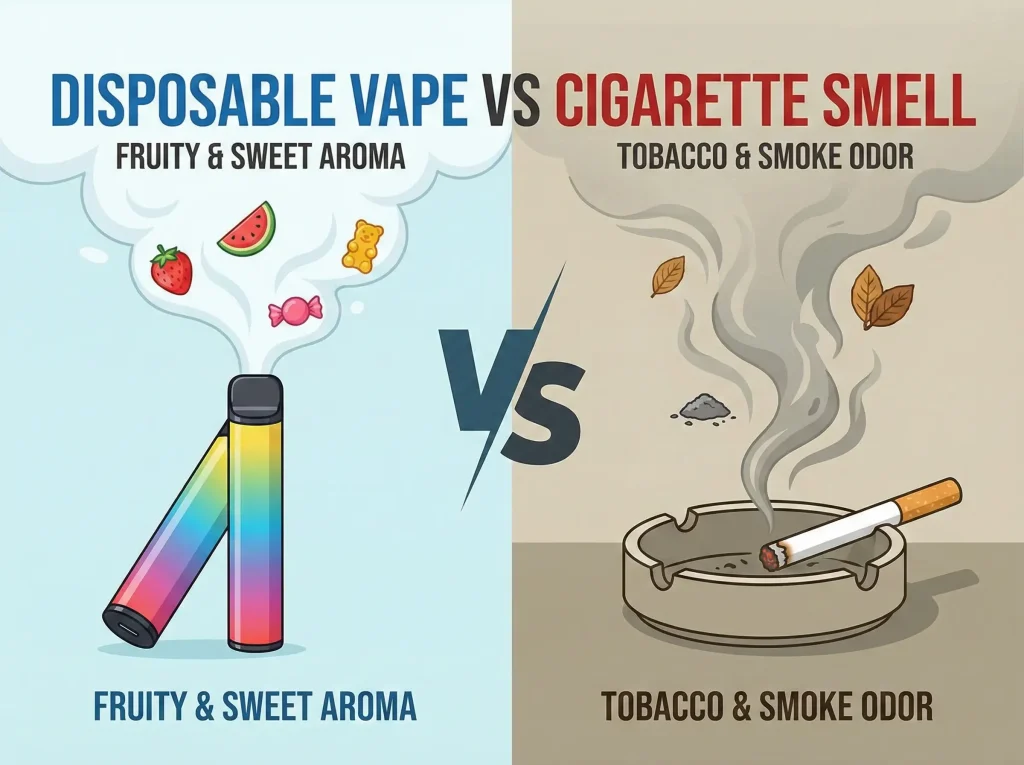
How Odor Is Created, How Long It Lingers, and What People Actually Notice
One of the most noticeable differences between disposable vapes and traditional cigarettes is smell. Long before people compare health risks, nicotine levels, or cost, they usually ask a much more immediate question: How does it smell, and will other people notice?
Smell affects social interactions, indoor environments, clothing, and even personal identity. Many users switch from cigarettes to disposable vapes specifically because they want to avoid the strong, lingering odor associated with smoking. Others worry whether vaping leaves a smell in rooms, on clothes, or on their breath.
This article takes a detailed, science-based look at how cigarette smell and disposable vape smell differ, why those differences exist, and what people around you can realistically detect.
Key Takeaways
- Cigarettes produce a much stronger and longer-lasting smell than disposable vapes.
This is because cigarettes rely on combustion, which creates tar, ash, and sticky smoke particles that easily cling to fabrics, walls, and surfaces. - Disposable vape odor is created by aerosolized liquid, not smoke.
Vape smell mainly comes from flavor compounds and PG/VG vapor, which are more water-based and tend to dissipate faster than cigarette smoke residue. - Cigarette smell lingers because it binds to surfaces and re-releases over time.
Smoke particles embed themselves into porous materials like clothing, upholstery, and walls, causing odor to return even after ventilation. - Vape odor is usually temporary and easier to remove, but it is not completely invisible.
In well-ventilated spaces, vape smell often fades within minutes, though frequent indoor vaping can still leave a mild residual scent. - Vaping does not typically make people smell “bad” the way cigarettes do.
Cigarette smoke commonly sticks to hair, skin, and clothing, while vape scent is lighter and usually fades quickly. - People may notice vaping immediately after use, but detection drops rapidly over time.
Vape smell is often noticeable only shortly after vaping and is highly dependent on flavor choice, room size, and airflow. - Reduced odor does not mean zero impact on indoor environments.
While disposable vapes are less intrusive than cigarettes in terms of smell, responsible use and proper ventilation still matter in shared spaces.
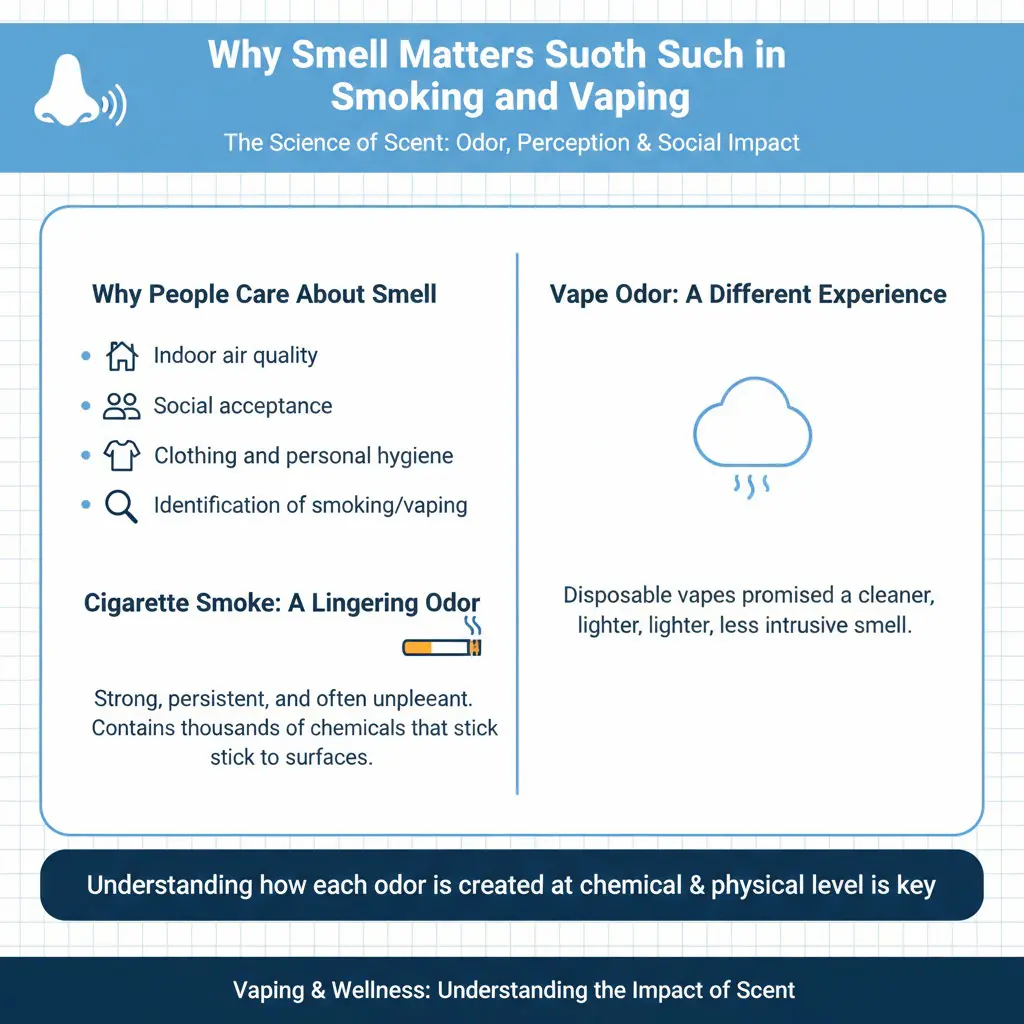
Why Smell Matters So Much in Smoking and Vaping
Smell is one of the strongest sensory signals in human perception. Unlike vapor visibility, which disappears quickly, odor can linger and create lasting impressions.
People care about smell because it affects:
- Indoor air quality
- Social acceptance
- Workplace and home environments
- Clothing and personal hygiene
- How easily others can identify smoking or vaping behavior
For decades, cigarette smoke has been associated with a strong, persistent odor that many non-smokers find unpleasant. Disposable vapes entered the market promising a different experience—one that feels cleaner, lighter, and less intrusive.
Understanding whether that promise holds true requires looking at how each odor is created at a chemical and physical level.
How Cigarette Smell Is Created
Cigarette smell is not “just tobacco.” What you’re smelling is the result of combustion chemistry—the complex chain of reactions that happens when tobacco and paper burn at high temperatures. Unlike vaping (which heats a liquid), smoking breaks down solid plant material, paper, and additives into a mixture of gases and microscopic particles. That mixture has a strong odor because it contains many highly reactive and sticky compounds that your nose detects easily.
1) Combustion creates a much larger “odor payload.”
When a cigarette burns, it generates:
- Smoke particles (tiny solids and liquid droplets)
- Volatile organic compounds (VOCs) (odor-carrying gases)
- Semi-volatile compounds that can travel in the air and then condense onto surfaces
- Byproducts from burning paper, which add a distinct “ashy” and “burnt” smell
This matters because odor intensity isn’t only about what’s in the smoke—it’s about how much is produced and how easily it spreads. Combustion creates a dense mix that diffuses quickly through a room.
2) Tar is the main reason the cigarette odor “sticks.”
“Tar” isn’t one single chemical. It’s a sticky mixture of many compounds produced by burning. Think of tar like an odor glue:
- It carries strong-smelling chemicals
- It coats surfaces in a thin film
- It traps odor molecules and slowly releases them back into the air
That’s why the cigarette smell tends to cling to:
- fabrics (clothing, curtains, couches)
- drywall and paint
- car interiors
- hair and skin oils
Practical analogy: Cigarette smoke behaves more like cooking grease than like perfume. Perfume evaporates; grease coats. Cigarette smoke contains components that behave more “grease-like,” so the smell persists.
3) Smoke particles are tiny and “surface-seeking.”
Cigarette smoke contains microscopic particles that are small enough to:
- drift deep into fabric fibers
- settle into porous materials
- collect in corners and ventilation ducts
Once smoke reaches these micro-spaces, ordinary airing out often isn’t enough. The odor becomes embedded until the residue is physically removed (washing, wiping, shampooing carpets, repainting in severe cases).
Tip: If a room still smells after ventilation, it usually means the odor is no longer “in the air”—it’s on surfaces.
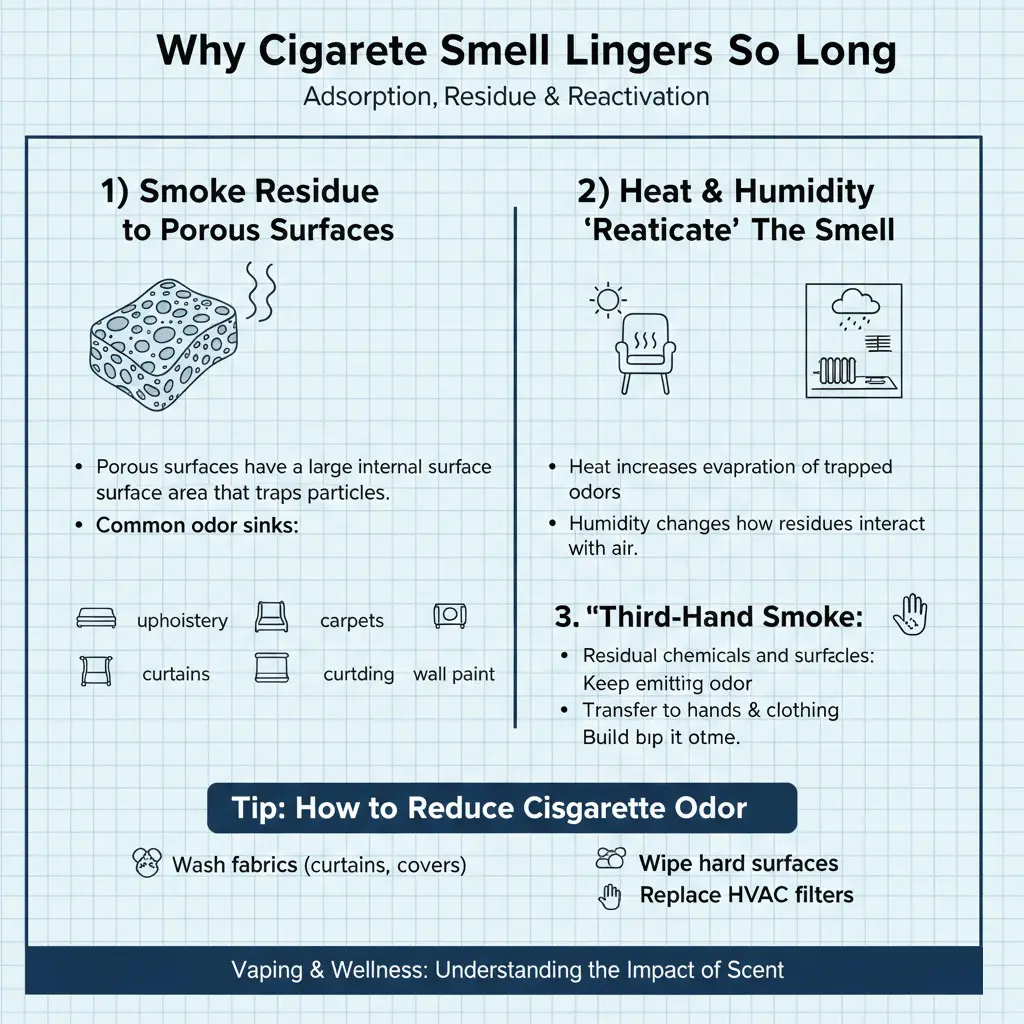
Why Cigarette Smell Lingers So Long
Many people assume the cigarette smell lingers because “the air is contaminated.” In reality, the bigger reason is adsorption (odor molecules sticking to surfaces) and re-emission (those molecules gradually returning to the air).
1) Smoke residue binds to porous surfaces extremely well
Porous surfaces have a large internal surface area. Even if something looks smooth, it can contain microscopic gaps that trap particles and odor compounds.
Common odor sinks include:
- upholstery and foam cushions
- carpets and rugs
- blankets and bedding
- curtains
- unsealed wood
- wall paint and drywall
- HVAC filters and vents
When smoke enters a room, these surfaces behave like a sponge for odor.
2) Heat and humidity “reactivate” the smell
Have you ever noticed cigarette smell comes back on a warm day? That’s because:
- Heat increases the evaporation of trapped odor compounds
- Humidity changes how residues interact with air
- Warm surfaces release volatile compounds faster
This is why a car or room can smell worse when:
- Sunlight heats upholstery
- A heater turns on
- humidity rises
3) “Third-hand smoke” is basically smell + residue that remains
The term “third-hand smoke” is used to describe the residual chemicals and particles left on surfaces after smoking. Even without visible smoke, those residues can:
- keep emitting odor
- transfer to hands and clothing
- build up over time
You don’t have to use that term heavily in your article if you want it less “medical,” but it’s a useful concept for explaining why smell is persistent.
Tip : If you want to reduce cigarette odor in a room, focus on:
- washing fabrics (curtains, covers)
- wiping hard surfaces
- replacing HVAC filters Ventilation helps, but cleaning is what actually removes the odor source.
Do Cigarettes Smell More Than Vapes?
In nearly all environments, cigarettes produce a stronger and more persistent smell than disposable vapes.
Cigarette odor is:
- Sharper
- More penetrating
- Easier to detect from a distance
Disposable vape odor is typically:
- Milder
- More localized
- Dependent on flavor choice
The difference becomes especially obvious in enclosed spaces. Where cigarette smoke can fill a room and remain noticeable long after use, vape aerosol usually dissipates within minutes under normal ventilation.
👉 Want to know which vape flavors smell the strongest? Read our full guide here.
Do Vapes Leave a Smell in Your Room?
This is one of the most common concerns among vape users.
Short-Term Effects
Immediately after vaping indoors, a room may smell faintly of the chosen flavor—such as fruit, mint, or dessert notes. This smell is usually:
- Light
- Non-irritating
- Temporary
In a well-ventilated room, the scent often disappears within minutes.
Long-Term Effects
Over time, heavy or frequent vaping in a poorly ventilated space can lead to:
- Mild residual odor
- Light film on surfaces in extreme cases
However, this buildup is significantly less intense and far easier to remove than cigarette residue. There is no equivalent to the thick, yellowish tar accumulation associated with smoking.
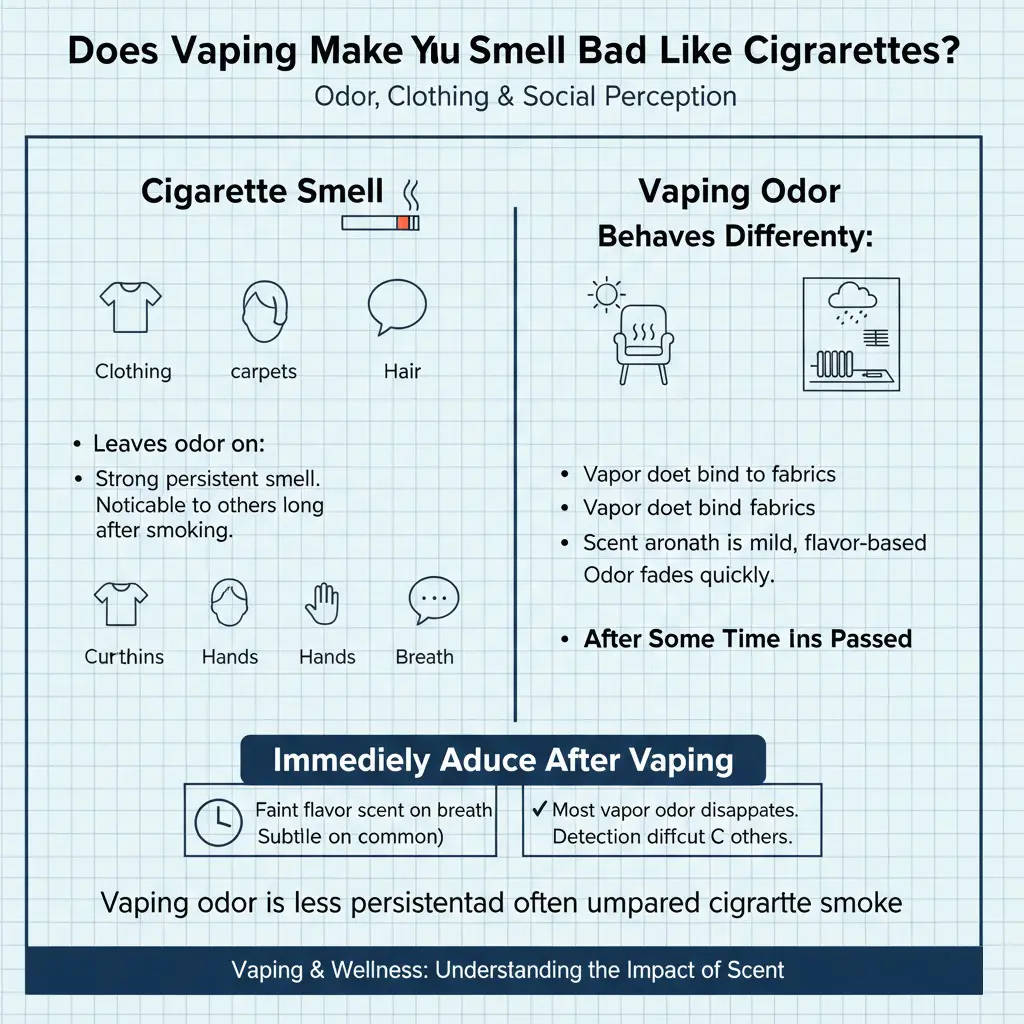
Does Vaping Make You Smell Bad Like Cigarettes?
For most users, vaping does not create the same “smoker smell” associated with cigarettes.
Cigarette smoking commonly leaves an odor on:
- Clothing
- Hair
- Hands
- Breath
This smell is often noticeable to others, even if the person is not actively smoking.
Disposable vapes behave differently:
- Vapor does not strongly bind to fabrics
- Any scent on breath is usually mild and flavor-based
- Odor fades quickly
In many cases, people nearby may not perceive vaping odor at all, especially after a short period.
Can You Smell If Someone Has Vaped?
The answer depends on timing and context.
Immediately After Vaping
Right after vaping, someone may carry:
- A faint scent on their breath
- A subtle aroma from clothing if vaping occurred in proximity
This is more likely with strong or sweet flavors.
After Some Time Has Passed
Once several minutes pass:
- Most vape-related odor dissipates
- Clothing typically does not retain smell
- Detection becomes difficult for others
In contrast, cigarette smoke odor remains detectable long after smoking ends.
Why Vape Smell Is Socially Perceived Differently
Smell perception is not purely chemical—it is also cultural.
Cigarette smoke has decades of negative social associations, including:
- Health risks
- Secondhand smoke concerns
- Indoor pollution
Vape odor, especially flavored vapor, is often perceived as:
- Less intrusive
- Less aggressive
- More socially acceptable in some settings
This does not mean vaping is universally welcomed indoors, but the sensory response is generally less negative.
Does Vape Smell Stick to Clothes?
Under normal use, vape aerosol does not strongly adhere to clothing. Most fabrics do not absorb vapor particles the way they absorb smoke.
Factors that increase the chance of scent transfer include:
- Vaping is in very close contact with fabric
- Using strong, sweet flavors
- Poor ventilation
Even in these cases, the smell usually fades quickly without washing.
Smell Comparison Summary
| Aspect | Cigarettes | Disposable Vapes |
| Odor intensity | Very strong | Mild to moderate |
| Lingering time | Hours to days | Minutes |
| Clothing absorption | High | Low |
| Room residue | Heavy | Minimal |
| Detectability by others | Easy | Often subtle |
Smell Comparison Summary
Practical Tips to Minimize Odor
For cigarette users:
- Smoke outdoors
- Change clothes after smoking
- Ventilate indoor spaces thoroughly
For disposable vape users:
- Vape in well-ventilated areas
- Avoid excessive indoor use
- Choose lighter or mint-based flavors if odor sensitivity is a concern
Conclusion: Disposable Vape Smell vs Cigarette Smell
From a sensory standpoint, cigarette smell is stronger, more persistent, and more intrusive than disposable vape smell. This difference exists because smoking involves combustion, while vaping produces an aerosol that behaves differently in the air.
Disposable vapes may leave a temporary scent, especially immediately after use, but they do not create the heavy, lingering odor that cigarettes are known for. For many users, this difference plays a major role in choosing vaping over smoking.
That said, reduced odor does not mean zero impact. Indoor use, shared spaces, and consideration for others still matter.
FAQ
Do cigarettes smell more than vapes?
Yes. Cigarettes produce stronger and longer-lasting odors due to combustion.
Do vapes leave a smell in your room?
They may leave a temporary scent, but it usually dissipates quickly.
Does vaping make you smell bad like cigarettes?
Generally no. Vape odor is lighter and less persistent.
Can people tell if you vape?
Sometimes, immediately after vaping, but detection becomes difficult over time.
Does vape smell stick to clothes?
Not usually. Any scent typically fades quickly.