
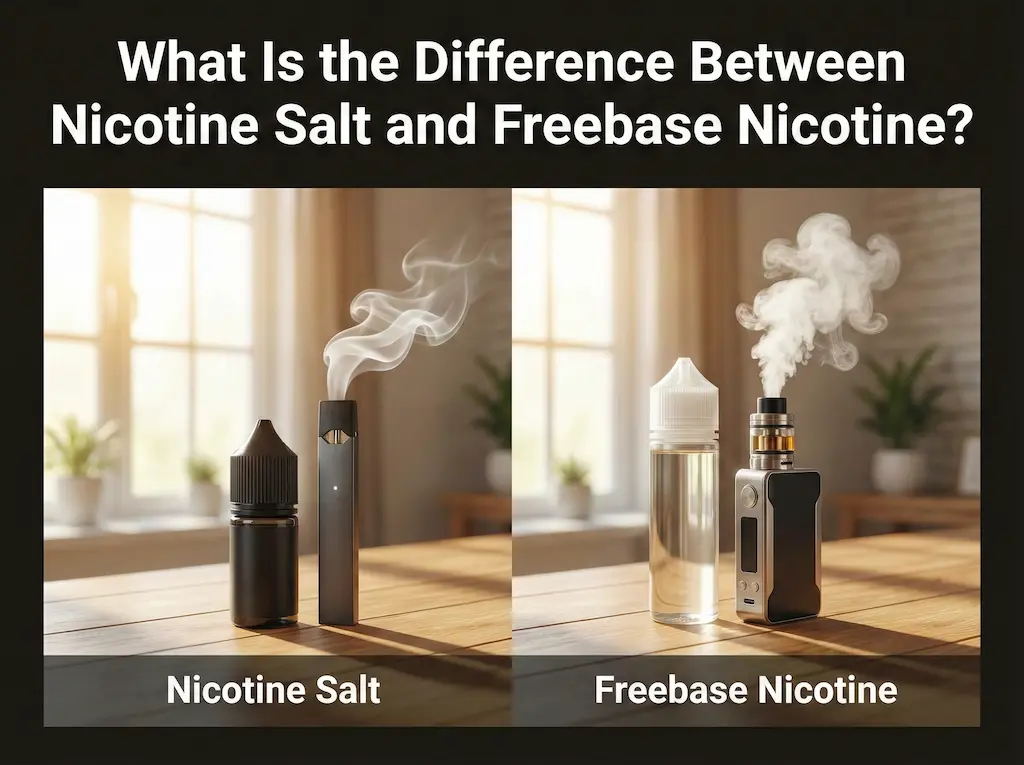
When people first learn about vaping, one of the most confusing topics is nicotine itself. Bottles may list the same milligram strength, yet the experience feels completely different. Some e-liquids feel smooth and satisfying within a few puffs, while others feel harsher but allow longer, more relaxed sessions.
This difference is not accidental. It comes from two fundamentally different forms of nicotine used in e-liquids: freebase nicotine and nicotine salt.
Understanding how these two types work—and why they feel so different—helps users choose the right product, avoid discomfort, and prevent common mistakes that shorten coil life or reduce satisfaction.
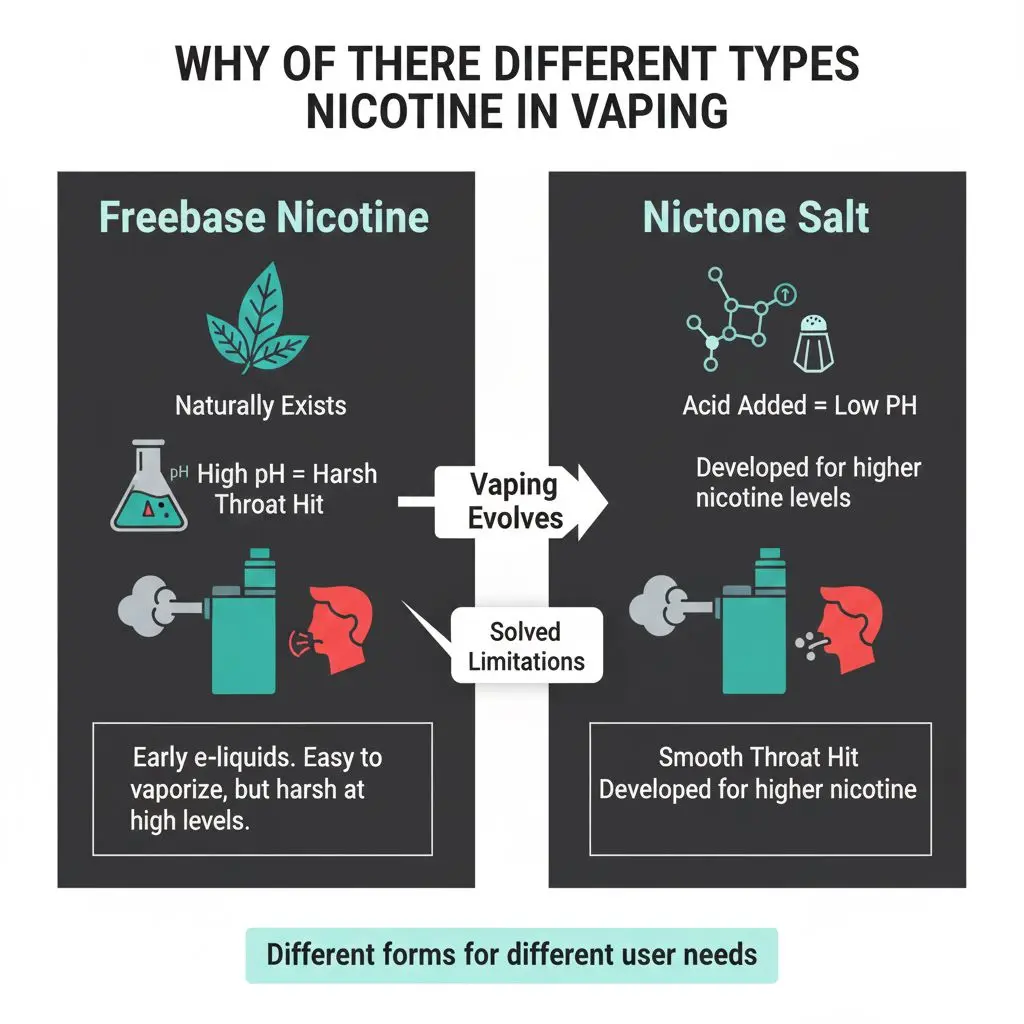
Why There Are Different Types of Nicotine in Vaping
Nicotine itself is not new. It has been studied for decades and has always existed naturally in tobacco leaves. However, how nicotine behaves when heated, inhaled, and absorbed depends heavily on its chemical form.
Early e-liquids used freebase nicotine because it was the most accessible and easiest to vaporize. As vaping evolved, manufacturers realized that freebase nicotine had limitations—especially for users who wanted higher nicotine levels without harshness.
Nicotine salt was developed as a response to those limitations. It wasn’t created to replace freebase nicotine, but to solve specific problems that freebase could not.
What Is Freebase Nicotine?
Freebase nicotine is nicotine in its most basic, unbound form. Chemically, it is alkaline, which directly affects how it feels when inhaled.
This alkalinity creates what many users describe as a throat hit—a sharp sensation at the back of the throat when vapor is inhaled. At low nicotine levels, this sensation can feel satisfying or familiar, especially to former smokers. At higher concentrations, however, it quickly becomes uncomfortable or even irritating.
Due to this, freebase nicotine is typically used at lower strengths and paired with higher-powered devices. These devices produce more vapor, allowing users to absorb nicotine through volume rather than concentration.
Freebase nicotine became popular because it:
- Works well in sub-ohm and high-wattage devices
- Supports longer vaping sessions
- Allows detailed flavor development
- Provides a noticeable but controllable throat hit
For many experienced users, freebase nicotine remains the preferred choice for daily vaping.
What Is Nicotine Salt?
Nicotine salt is nicotine combined with an organic acid. This changes its chemical behavior in several important ways.
First, nicotine salt is less alkaline, which significantly reduces throat irritation. This allows much higher nicotine concentrations to be inhaled comfortably, even with small amounts of vapor.
Second, nicotine salt is more stable when heated at lower temperatures. This makes it ideal for compact, low-power devices such as pod systems.
Most importantly, nicotine salt delivers nicotine to the bloodstream more efficiently and more quickly. Many users feel satisfied after just a few puffs, rather than needing a prolonged session.
Nicotine salt was introduced to address the needs of:
- Smokers transitioning to vaping
- Users who prefer small, discreet devices
- People who want faster nicotine satisfaction
- Users sensitive to throat irritation
How Freebase and Nicotine Salt Actually Feel Different
From a user’s perspective, the biggest difference between freebase and nicotine salt is not the label—it’s the physical sensation.
Freebase nicotine usually feels:
- Sharper on the throat
- More noticeable during inhalation
- Gradual in nicotine delivery
- Better suited for long sessions
Nicotine salt usually feels:
- Smoother and softer when inhaled
- Less irritating, even at high strength
- Faster in delivering nicotine
- Better for short, efficient use
Neither sensation is “better” by default. They are simply designed for different usage patterns.
Nicotine Absorption: Why Satisfaction Happens at Different Speeds
One of the most misunderstood aspects of vaping is how nicotine is absorbed.
Freebase nicotine enters the bloodstream more slowly. This is why users often take multiple puffs over a longer period to feel satisfied. The experience is similar to sipping a drink rather than taking a shot.
Nicotine salt, on the other hand, is absorbed more rapidly. The body recognizes it quickly, which explains why users often report feeling satisfied after fewer puffs.
This difference explains many common user observations:
- “Nicotine salt hits faster.”
- “Freebase feels weaker, but lasts longer.”
- “Salt feels stronger even at the same number.”
The difference is not just strength—it is delivery speed.
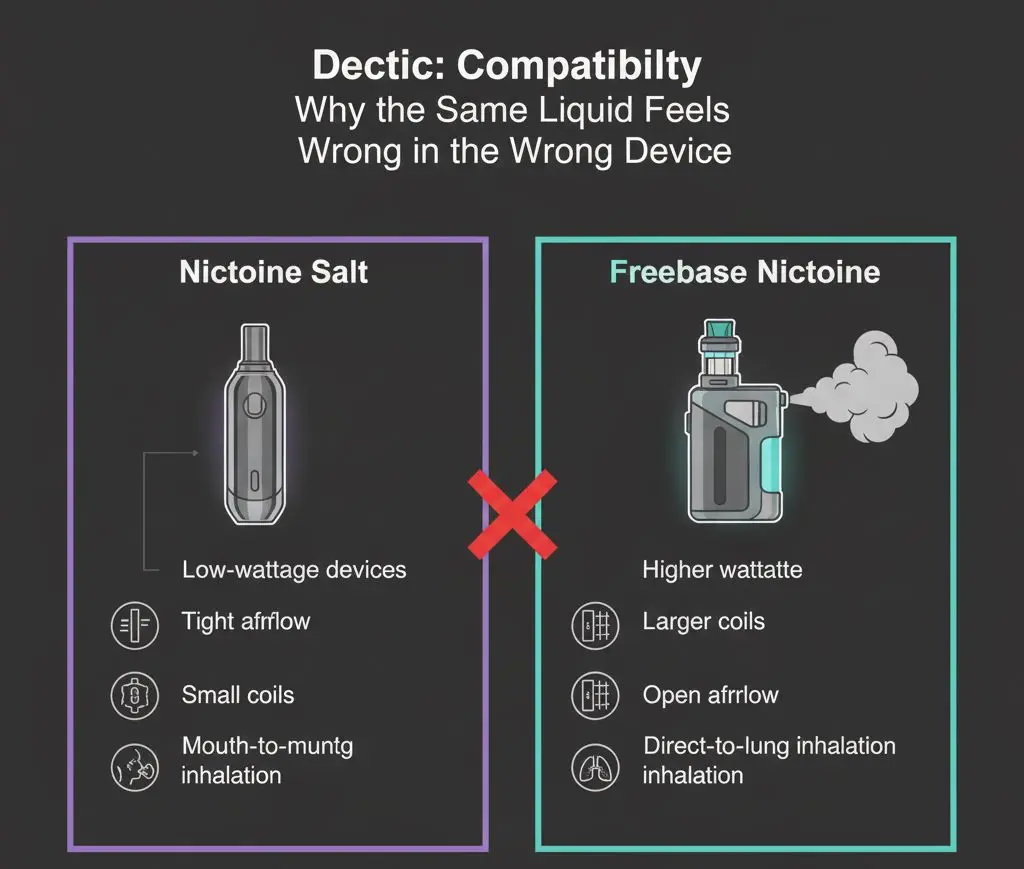
Device Compatibility: Why the Same Liquid Feels Wrong in the Wrong Device
Nicotine type and device design are closely connected. Problems often arise when users mix the wrong nicotine type with the wrong device.
Nicotine salt works best with:
- Low-wattage devices
- Tight airflow
- Small coils
- Mouth-to-lung inhalation
Freebase nicotine works best with:
- Higher wattage
- Larger coils
- Open airflow
- Direct-to-lung inhalation
Using nicotine salt in a high-power device often results in excessive nicotine intake and discomfort. Using freebase nicotine in a low-power pod may feel weak or unsatisfying.
Comparison Table: Nicotine Salt vs Freebase Nicotine
| Aspect | Freebase Nicotine | Nicotine Salt |
| Throat sensation | Stronger throat hit | Smooth inhale |
| Typical nicotine level | Low to medium | Medium to high |
| Absorption speed | Slower | Faster |
| Best device type | Sub-ohm / high power | Pod systems |
| Puff style | Long and frequent | Short and efficient |
| Target users | Flavor-focused users | Satisfaction-focused users |
Which Is Better: Freebase or Salt Nic?
This question appears frequently in search results, but it has no universal answer.
Nicotine salt may be better if you:
- Want fast satisfaction
- Use compact devices
- Prefer fewer puffs
- Are sensitive to throat irritation
Freebase nicotine may be better if you:
- Enjoy extended sessions
- Prefer strong flavor layers
- Use high-power devices
- Like a noticeable throat hit
The “better” option is the one that fits your habits, device, and comfort level.
Is Nicotine Salt Better Than E-Liquid?
This question is based on a misunderstanding.
Nicotine salt is not separate from e-liquid. It is simply one type of nicotine used inside e-liquid. Freebase nicotine is another.
Comparing nicotine salt to e-liquid is like comparing sugar to soda. One is an ingredient; the other is the final product.
Which Form of Nicotine Is Best Overall?
From an industry and safety perspective, neither form replaces the other.
Freebase nicotine remains essential for:
- Advanced vaping setups
- Low-nicotine users
- Flavor exploration
Nicotine salt remains essential for:
- Beginners
- Pod-based devices
- Higher nicotine needs
Both exist because users have different goals and preferences.
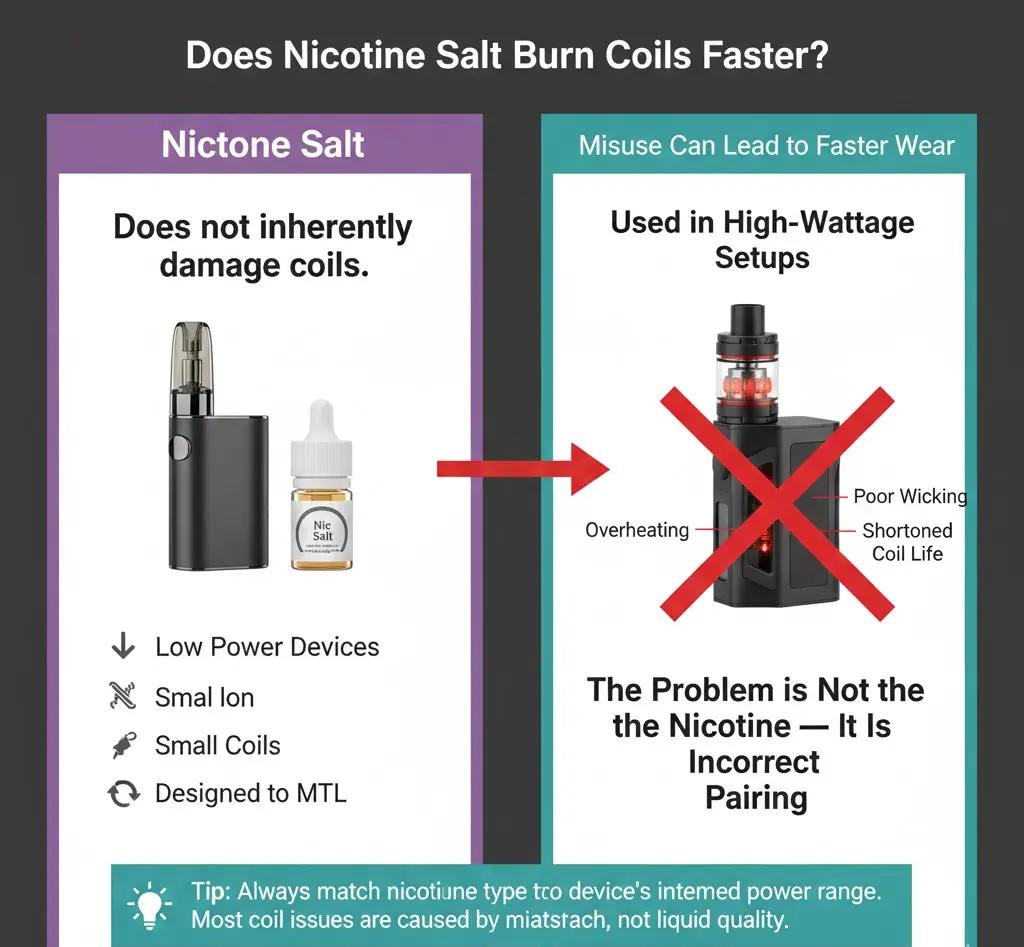
Does Nicotine Salt Burn Coils Faster?
Nicotine salt itself does not inherently damage coils.
However, misuse can lead to faster coil wear. Nicotine salt is specifically designed for use with low-power devices. When used in high-wattage setups, it can cause overheating, poor wicking, and shortened coil life.
The problem is not the nicotine—it is an incorrect pairing.
Tip: Always match nicotine type to the device’s intended power range. Most coil issues are caused by mismatch, not liquid quality.
Final Thoughts
The difference between nicotine salt and freebase nicotine is not marketing hype—it is chemistry applied to real-world usage.
Freebase nicotine offers control, flavor depth, and longer sessions. Nicotine salt offers efficiency, smoothness, and rapid satisfaction. Neither is inherently superior, and both continue to play important roles in modern vaping.
Understanding how they form, how they are absorbed, and how they interact with devices allows users to make informed choices rather than relying on assumptions.
In vaping, the best experience comes from alignment—between nicotine type, device, and personal habits.
FAQ
Which is better, freebase or salt nicotine?
Neither is objectively better. Freebase nicotine is better suited for higher-power devices and longer vaping sessions, while nicotine salt works best for low-power pod systems and faster nicotine satisfaction. The best choice depends on your device and usage habits.
Is nicotine salt better than e-liquid?
Nicotine salt is not separate from e-liquid. It is simply one form of nicotine used within e-liquid. Freebase nicotine is another. Comparing nicotine salt to e-liquid is a misunderstanding of how vape liquids are formulated.
Which form of nicotine is best for beginners?
For beginners, nicotine salt is often easier to start with because it provides smoother inhalation and quicker satisfaction at lower vapor output. However, beginners using higher-power devices may find freebase nicotine more suitable.
Why does nicotine salt feel stronger than freebase?
Nicotine salt is absorbed more efficiently by the body, so users often feel satisfied more quickly. This faster absorption is often perceived as “stronger,” even when the nicotine strength is similar.
Can I switch between nicotine salt and freebase?
Yes, but you should adjust your device and nicotine strength accordingly. Switching without changing settings may result in harshness, weak satisfaction, or discomfort.
Is freebase nicotine outdated?
No. Freebase nicotine remains widely used, especially by experienced users who prefer lower nicotine levels, stronger flavor expression, and higher vapor production.
You Can Read More
15-Year Vape Chemist Daniel Explains Salt Nic vs Freebase Nic: Key Differences
What Are the Components of Electronic Cigarette E-Liquid? (Full Scientific Guide)
How long 100 milliliters of e-liquid can last
How to Treat Mouth Sores From Vaping? A Clear, Science-Based Guide