
Health Risks, Air Quality, and Effects on Your Home
As vaping becomes more common, many people are choosing to use e-cigarettes inside their homes, apartments, or shared indoor spaces. Because vaping does not produce smoke in the traditional sense, it is often assumed to be harmless indoors. However, this assumption is not entirely accurate.
This article explores whether vaping indoors is harmful, how it affects people in the same room, what it does to indoor air quality, and whether it can damage walls or household surfaces over time.
Key Takeaways – Is Vaping Indoors Harmful?
- Vaping indoors releases aerosols into shared air.
- Vape aerosol is not harmless, even though it lacks smoke.
- Being in a room with people vaping can cause low-level exposure.
- Indoor vaping can leave light residue on walls and surfaces.
- Good ventilation reduces—but does not eliminate—risk.
What Happens When You Vape Indoors? (Detailed Explanation)
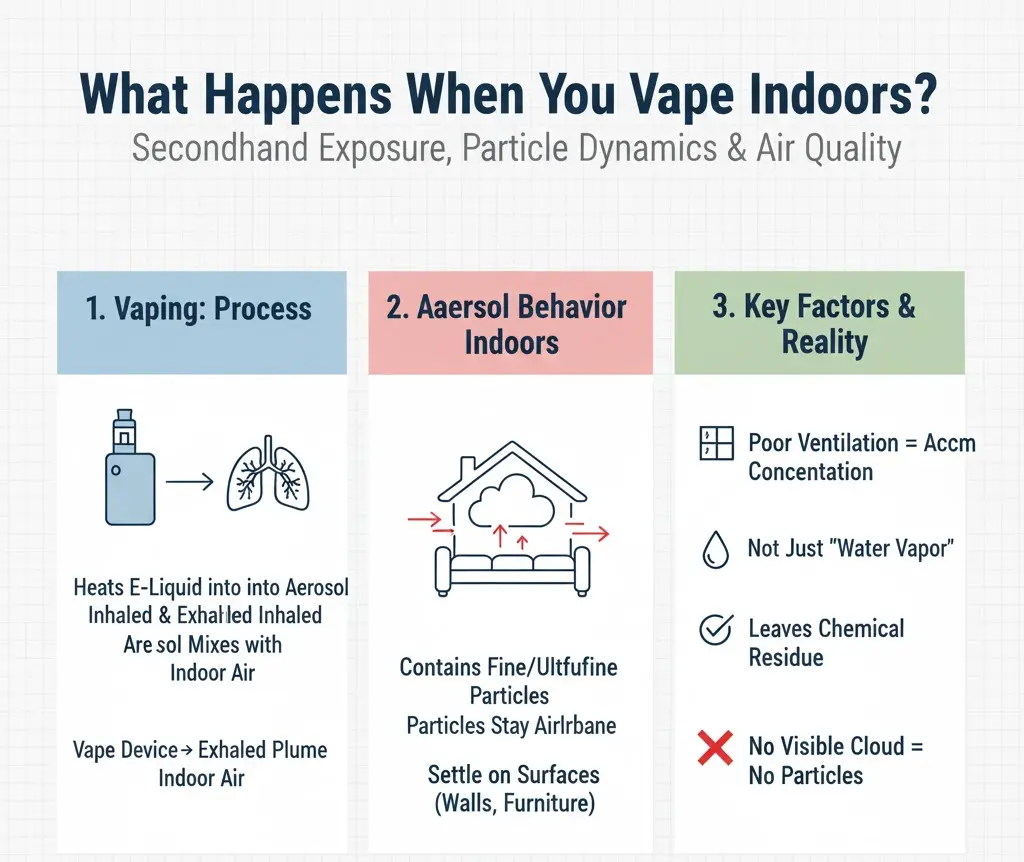
When someone vapes indoors, the electronic cigarette heats e-liquid into an aerosol that is inhaled and then exhaled back into the surrounding environment. This aerosol does not disappear immediately. Instead, it mixes with indoor air and begins to disperse throughout the room.
In enclosed or poorly ventilated spaces, such as bedrooms, living rooms, cars, or apartments, this aerosol can remain suspended in the air for a noticeable period of time. Unlike outdoor environments, where air movement quickly dilutes particles, indoor air circulation is limited. As a result, aerosol particles can accumulate—especially when vaping occurs repeatedly or continuously.
A key factor is particle size. Vape aerosol contains fine and ultrafine particles that are light enough to stay airborne rather than settling immediately. These particles can:
- Drift across the room
- Be inhaled by other people nearby
- Settle slowly on surfaces over time
Room conditions significantly affect how long aerosol remains present. In smaller rooms, the concentration rises faster. In spaces with closed windows or minimal airflow, particles linger longer. Even when the visible cloud disappears, microscopic particles may still be present in the air.
It is also important to understand that vape aerosol is not simply water vapor. Water vapor disperses quickly and leaves no residue. Vape aerosol, by contrast, contains chemical carriers and flavor compounds that behave more like airborne pollutants than steam. This distinction explains why indoor vaping can affect air quality even when no visible cloud remains.
Is Vape Smoke Harmful in the Air? (Expanded Analysis)
Although many people refer to it as “vape smoke,” the substance released by electronic cigarettes is technically an aerosol—a mixture of gases and suspended particles. This difference matters because aerosols can interact with indoor air and human lungs in ways that pure vapor cannot.
Studies have shown that vape aerosols may contain:
- Nicotine, which can be inhaled by bystanders
- Propylene glycol (PG) and vegetable glycerin (VG), which form the base of the aerosol
- Flavoring compounds, some of which may irritate airways when inhaled
- Ultrafine particles, small enough to reach deep lung regions
- Trace metals, such as nickel or chromium, are released from heating elements
While the overall number of toxic compounds is lower than in cigarette smoke, this does not mean indoor air is unaffected. Ultrafine particles are particularly important because they can penetrate deeply into the respiratory system and remain airborne longer than larger particles.
Repeated exposure matters more than single exposure. One brief vaping session in a well-ventilated space is unlikely to cause noticeable effects for most healthy adults. However, repeated indoor vaping, especially in confined spaces, can raise background particle levels and reduce overall indoor air quality.
Short-term exposure may lead to:
- Throat or nasal irritation
- Headaches
- Eye discomfort
- Increased coughing in sensitive individuals
People with asthma, allergies, or respiratory conditions may notice symptoms more quickly. Children may also be more affected because they breathe faster and inhale more air relative to body size.
Long-term health effects of indoor vape aerosol exposure are still being studied. Because widespread vaping is relatively new, health agencies emphasize caution rather than definitive conclusions. The lack of long-term data does not imply safety—it simply means research is ongoing.
For this reason, many public health experts recommend treating indoor vape aerosol as an avoidable indoor air contaminant, even if it is generally considered less harmful than cigarette smoke.
Is It Bad to Be in a Room With People Vaping?
Being in a room with people vaping means exposure to secondhand vape aerosol. While this exposure is generally lower risk than secondhand cigarette smoke, it is not risk-free.
Who Is Most Affected by Secondhand Vaping?
Certain groups are more sensitive to indoor vaping exposure:
- Children and teenagers
- Pregnant individuals
- People with asthma or respiratory conditions
- Individuals with heart conditions
- Pets with sensitive respiratory systems
For these groups, even low-level exposure may cause irritation or discomfort. Children, in particular, should not be routinely exposed to indoor vaping due to ongoing lung and brain development.
For healthy adults, occasional exposure in a well-ventilated room is unlikely to cause immediate harm, but repeated exposure in confined spaces increases potential risk.
While smell is the most noticeable effect of vaping indoors, some people also wonder whether what they’re breathing in has any impact beyond odor.
If you’re concerned about health risks rather than odor, you may also want to read our guide on secondhand vape exposure indoors.
Is Vaping Indoors Bad for Your House?
Beyond health concerns, many homeowners and renters wonder whether vaping indoors affects their living space.
The answer is: yes, vaping indoors can affect your home, though far less dramatically than smoking.
Does Vaping in the House Damage the Walls?
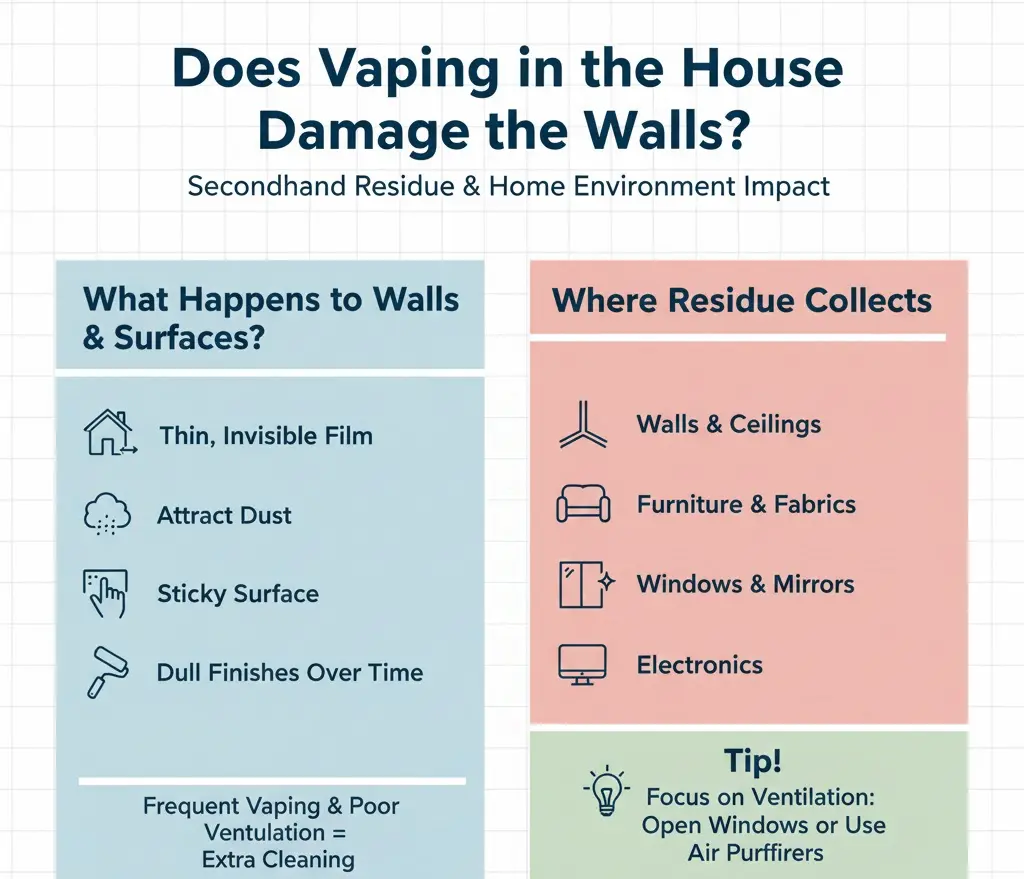
Vaping does not stain walls in the same way cigarette smoke does, but it can still leave subtle residue over time.
What Happens to Walls and Surfaces?
When vape aerosol settles, it can leave a thin, often invisible film on:
- Walls and ceilings
- Furniture
- Windows and mirrors
- Electronics and screens
- Curtains and carpets
This residue is usually colorless and light, but with frequent indoor vaping, it may:
- Attract dust
- Create a slightly sticky surface
- Dull, painted, or glossy finishes over time
In homes where vaping happens daily and ventilation is poor, walls may eventually require extra cleaning, especially near ceilings and vents.
Odor and Residue Buildup Indoors
One reason people vape indoors is that vape odors tend to fade faster than cigarette smoke. However, this does not mean odors disappear completely.
- Strongly flavored e-liquids can linger temporarily.
- Sweet or dessert flavors may leave a noticeable smell in fabrics.
- Repeated vaping can cause a subtle buildup, sometimes referred to as thirdhand exposure, where residue remains after the air clears.
Compared to smoking, cleanup is easier—but not nonexistent.
How Indoor Vaping Affects Air Quality
Indoor vaping can influence air quality by increasing levels of:
- Fine and ultrafine particles
- Nicotine traces
- Chemical aerosols
Ventilation plays a major role. In a well-ventilated room with open windows or air circulation, these particles disperse more quickly. In enclosed spaces, they remain longer and at higher concentrations.
Air purifiers may reduce some particles, but cannot fully eliminate nicotine or all chemical components from the air.
Indoor Vaping vs Smoking Indoors
Understanding the difference between vaping and smoking indoors helps put the risks in context.
| Aspect | Vaping Indoors | Smoking Indoors |
| Combustion | No | Yes |
| Tar and ash | No | Yes |
| Residue buildup | Light | Heavy |
| Odor persistence | Short-term | Long-lasting |
| Known long-term risks | Limited data | Well-established |
While vaping indoors is generally less harmful than smoking indoors, it is not harmless, especially with frequent use.
How to Reduce Harm if Vaping Indoors
If vaping indoors cannot be avoided, the following steps can reduce the impact:
- Open windows or use exhaust fans
- Avoid vaping in shared living spaces
- Keep vaping away from children’s rooms
- Reduce frequency indoors
- Regularly clean surfaces and fabrics
Setting clear household rules can help protect others while minimizing long-term buildup.
What Health Experts Say About Vaping Indoors
Public health organizations consistently state that:
- Vaping indoors is not harmless
- Secondhand exposure should be minimized
- Vulnerable individuals should not be exposed
- More long-term research is needed
This cautious stance reflects uncertainty rather than panic, emphasizing prevention over assumption.
FAQ – Vaping Indoors
Is vaping indoors harmful?
It is generally less harmful than smoking indoors, but it is not risk-free, especially with repeated exposure.
Is it bad to be in a room with people vaping?
Occasional exposure is usually low risk for healthy adults, but children and sensitive individuals should avoid it.
Does vaping in the house damage the walls?
It does not cause heavy staining, but frequent vaping can leave light residue over time.
Is vape smoke harmful in the air?
Vape aerosol contains particles and chemicals that can affect air quality, especially in enclosed spaces.
See more
How to Fix a Disposable Vape That Won’t Hit
Secondhand Vape Effects: What Happens When You’re Exposed to Vapor Indoors
How to Use a Disposable Vape Pen with a Button: A Beginner’s Step-by-Step Guide