

How Vape Devices and Detection Systems Really Work
Questions about vape detection have become increasingly common. Many people wonder whether carrying a disposable vape could trigger a metal detector or whether vape pens can set off alarms in places like airports, schools, or public buildings.
At the same time, there is widespread confusion between metal detectors and vape detectors, which are two very different systems designed for different purposes. Misunderstanding how these detectors work often leads to misinformation, exaggerated claims, and unrealistic expectations.
This article explains:
- Whether disposable vapes can trigger metal detectors
- How metal detectors differ from vape detectors
- What happens if a vape sets off a detector
- Why “avoiding detection” is not realistic or reliable
- What users should know about rules and policies
The goal is to provide clear, factual information without encouraging unsafe or rule-breaking behavior.

Why People Worry About Vape Detectors and Metal Detectors
Concerns about detection usually arise in specific environments, such as:
- Airports and transportation hubs
- Schools and universities
- Government buildings
- Indoor public spaces with no-vaping policies
Many people assume that all detectors work the same way. In reality, metal detectors and vape detectors are designed to detect completely different things, and confusing the two leads to incorrect assumptions.
Understanding the difference is the first step to understanding what actually happens.
Do Disposable Vapes Contain Metal?
Yes. Most disposable vapes contain metal components.
Even though disposable vapes are small and lightweight, they typically include:
- A lithium battery with a metal casing
- Internal wiring and contacts
- A heating element (usually metal wire or mesh)
- A small circuit board
Because of these components, disposable vapes are not metal-free objects. However, the presence of metal alone does not guarantee that a detector will be triggered.
Will a Disposable Vape Go Off in a Metal Detector?
The short answer is: it depends.
A disposable vape can trigger a metal detector, but it does not always do so. Whether an alarm is activated depends on several factors.
How Metal Detectors Actually Work
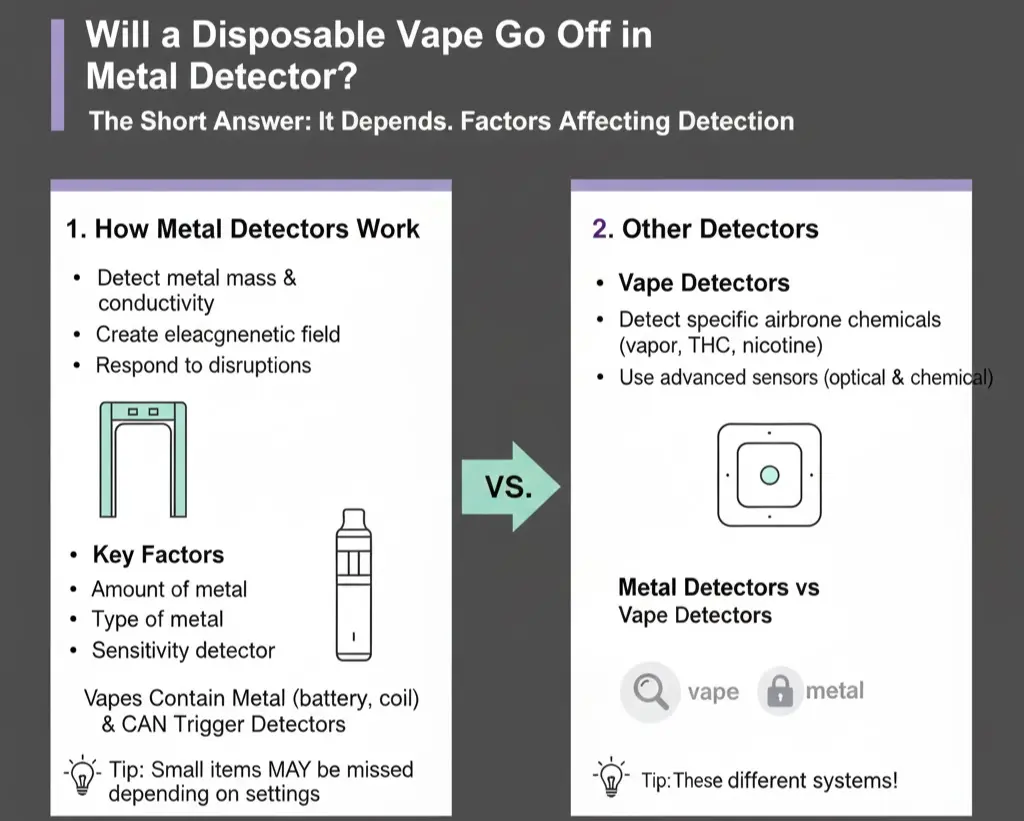
Metal detectors are designed to detect metal mass and conductivity, not specific products. They work by creating an electromagnetic field and responding when metal objects disrupt that field.
Key factors include:
- The amount of metal present
- The type of metal
- The sensitivity of the detector
Small electronic items often contain metal but may not trigger detectors set to detect larger or denser objects.
Factors That Affect Whether a Vape Triggers a Metal Detector
Several variables influence detection:
- Metal content size: Disposable vapes contain less metal than many common items, like phones or keys.
- Detector sensitivity: High-security checkpoints are more sensitive than basic walk-through detectors.
- Environment and settings: Airports, schools, and event venues may use different detection thresholds.
Because of these variables, there is no universal answer. In some situations, a vape may pass unnoticed; in others, it may be detected.
Do Vape Pens Alert Vape Detectors?
This is where confusion often occurs.
A vape detector is not a metal detector.
What Is a Vape Detector?
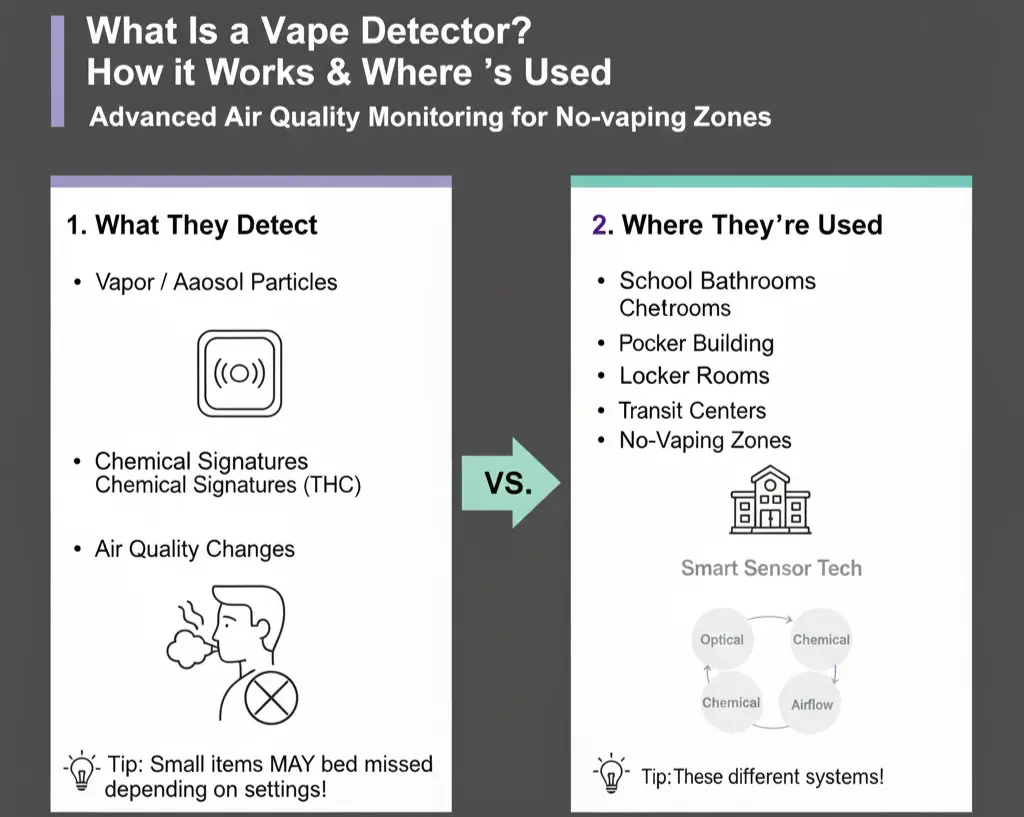
Vape detectors are devices designed to detect vapor or aerosol particles in the air, not physical objects. They are often installed in:
- School bathrooms
- Locker rooms
- Indoor spaces with strict no-vaping policies
These detectors monitor air quality changes associated with vaping, such as:
- Aerosol particle concentration
- Chemical signatures from vapor
They do not detect a vape device sitting unused in a pocket or bag.
Why Vape Detectors Are Installed
Vape detectors are typically installed to:
- Enforce indoor no-vaping rules
- Protect air quality
- Discourage vaping in restricted areas
They are triggered by vaping activity, not by possession of a device.
What Happens If a Vape Sets Off a Detector?
What happens next depends on the type of detector and the location.
If a Metal Detector Is Triggered
In places like airports or secured buildings:
- Security personnel may ask to identify the object
- The item may be inspected
- Local rules determine whether possession is allowed
Metal detectors are not designed to penalize vaping specifically; they are part of general security screening.
If a Vape Detector Is Triggered
In locations using vape detectors:
- The system records an event
- Staff or administrators may investigate
- Consequences depend on institutional policies
Responses vary widely depending on local rules, age restrictions, and building policies.
“How to Vape Without the Vape Detector Going Off?” — A Common Misunderstanding
This question appears frequently online, but it is based on a misunderstanding of how detection systems work.
Why This Question Is So Common
Social media posts and forums often:
- Oversimplify detection technology
- Share unreliable anecdotes
- Ignore environmental variables
This creates the false impression that detection can be easily controlled or avoided.

Why There Is No Reliable Way to Avoid Detection
Detection systems are specifically designed to:
- Monitor unpredictable environments
- Detect changes in air composition
- Reduce the effectiveness of avoidance attempts
Factors such as airflow, device output, detector sensitivity, and room size make outcomes unpredictable. Because of this, there is no consistent or reliable method to avoid triggering a vape detector, and attempting to do so can violate local rules.
Understanding and respecting policies is the safest approach.
Metal Detectors vs Vape Detectors: Key Differences
| Feature | Metal Detector | Vape Detector |
| Detects | Metal objects | Vapor / aerosol particles |
| Triggered by device alone | Possibly | No |
| Triggered by vaping activity | No | Yes |
| Common locations | Airports, security checks | Schools, indoor spaces |
| Purpose | Security screening | Air quality & policy enforcement |
Legal and Policy Considerations
Rules regarding electronic cigarettes vary widely by:
- Country
- State or region
- Institution or property owner
Even if possession of a vape is legal, using it in restricted areas may not be allowed. Detection systems are typically part of broader policies rather than standalone enforcement tools.
Checking and following local rules helps avoid unnecessary problems.
FAQ – Vape Detectors and Metal Detectors
Will a disposable vape go off in a metal detector?
It can, but not always. Detection depends on metal content and detector sensitivity.
Do vape pens alert metal detectors?
Vape pens contain metal and may be detected, but they are not guaranteed to trigger alarms.
What happens if a vape sets off a detector?
The response depends on the type of detector and the location’s policies.
Can vape detectors detect the device itself?
No. Vape detectors respond to vapor in the air, not unused devices.
Are vape detectors the same as smoke detectors?
No. Vape detectors are designed specifically to detect vaping-related aerosols, not smoke from fires.
Conclusion: Understanding Detection Helps Avoid Confusion
Disposable vapes contain metal and may trigger metal detectors in some situations, but outcomes depend on many variables. Vape detectors operate differently and are designed to detect vaping activity rather than devices.
The most important takeaway is that detection systems are not predictable or controllable. Understanding how they work—and respecting local rules—is the most reliable way to avoid issues.
Clear information helps users make informed decisions without relying on myths or misinformation.
You Can Read More
Will a disposable vape go off in a metal detector
What Is RDL Vaping? A Clear Beginner’s Guide to Restricted Direct Lung Vaping
What Should I Do if an Electronic Cigarette Leaks Oil? Common Causes and Practical Solutions