
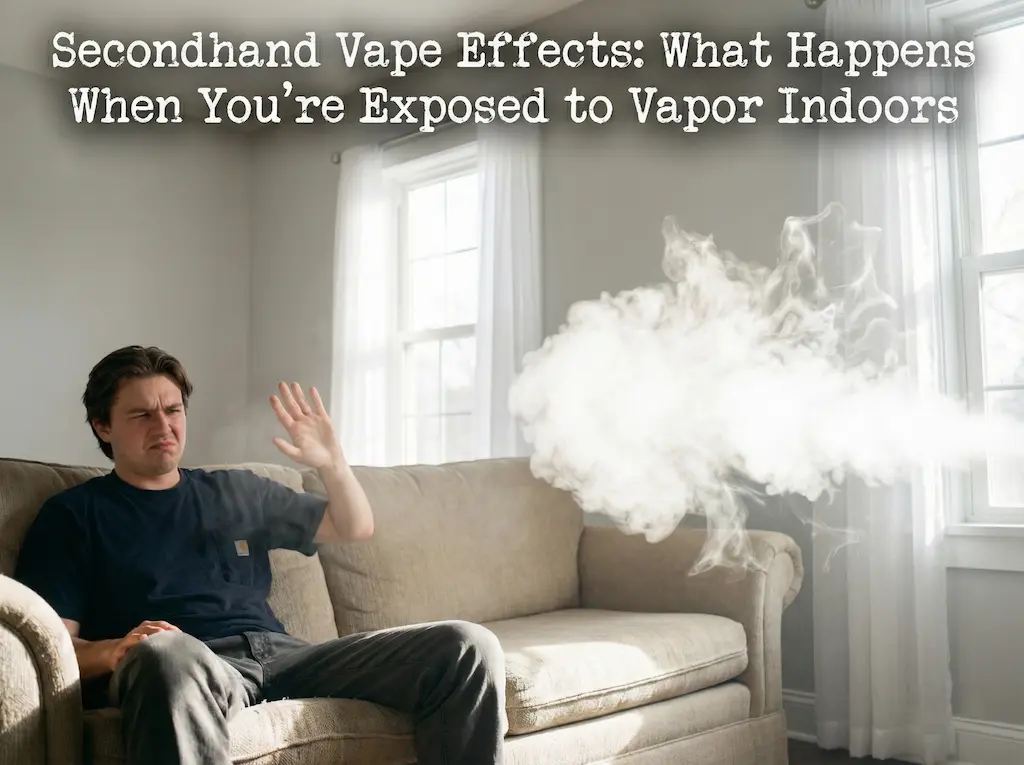
What Happens When You’re Exposed to Vapor Indoors
As electronic cigarettes become more common, questions about secondhand vape exposure are increasing—especially among families, roommates, and people living in shared indoor spaces. Many assume that because vaping does not produce smoke, it must be harmless to bystanders. However, the reality is more complex.
This article explains what secondhand vape aerosol is, what it contains, whether it can be harmful, how nicotine exposure works, and whether vaping indoors affects your home environment. While vaping is often considered less harmful than smoking, it is not risk-free for people nearby.
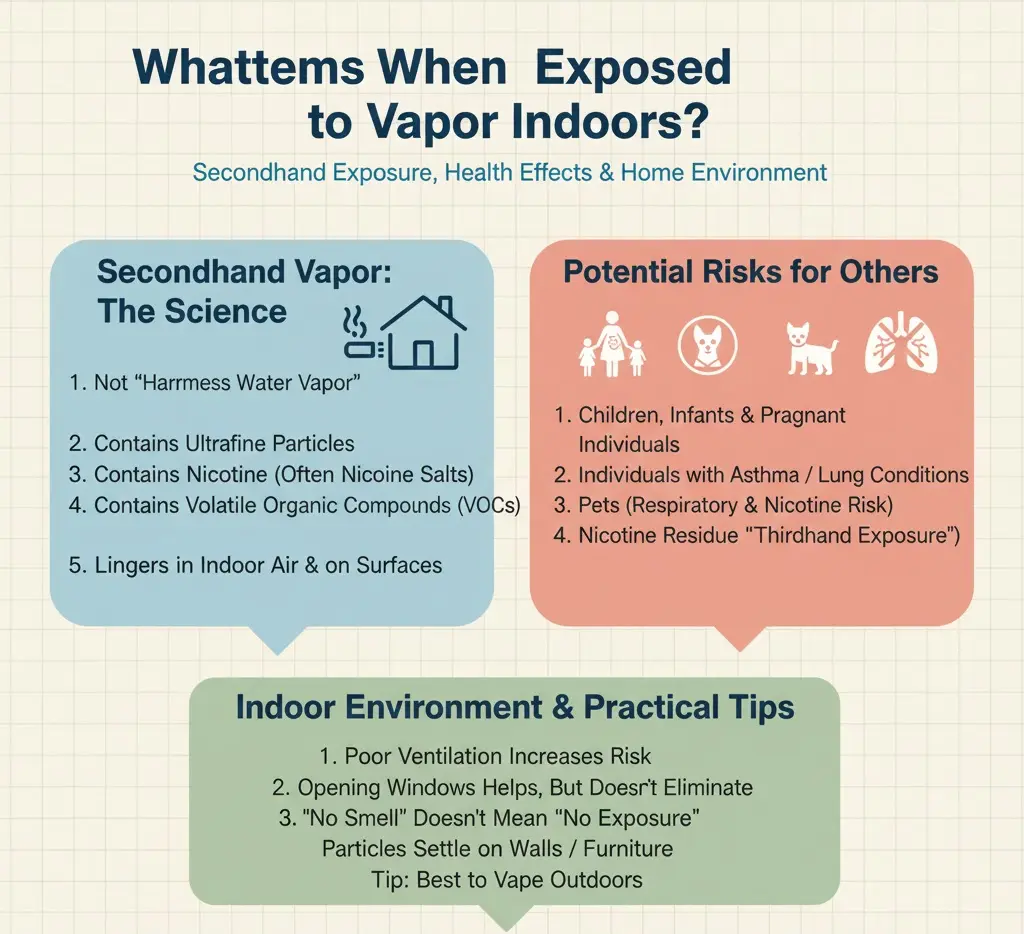
Key Takeaways – Secondhand Vape Effects
- Secondhand vape aerosol contains nicotine and other airborne substances.
- Exposure levels are usually lower than cigarette smoke, but not zero.
- Nicotine absorption from secondhand vaping is possible, especially indoors.
- Vaping indoors can leave light residue on surfaces over time.
- Ventilation and boundaries help reduce exposure, especially for children and sensitive individuals.
What Is Secondhand Vape Exposure?
Secondhand vape exposure refers to inhaling the aerosol exhaled by someone using an electronic cigarette. This aerosol is sometimes mistakenly called “vapor,” but it is not simply water vapor.
Unlike traditional cigarettes, e-cigarettes do not burn tobacco. Instead, they heat a liquid into an aerosol that contains fine particles and chemicals. When a user exhales, these substances enter the surrounding air, where others may breathe them in—especially in enclosed spaces.
What Is in Secondhand Vape Aerosol?
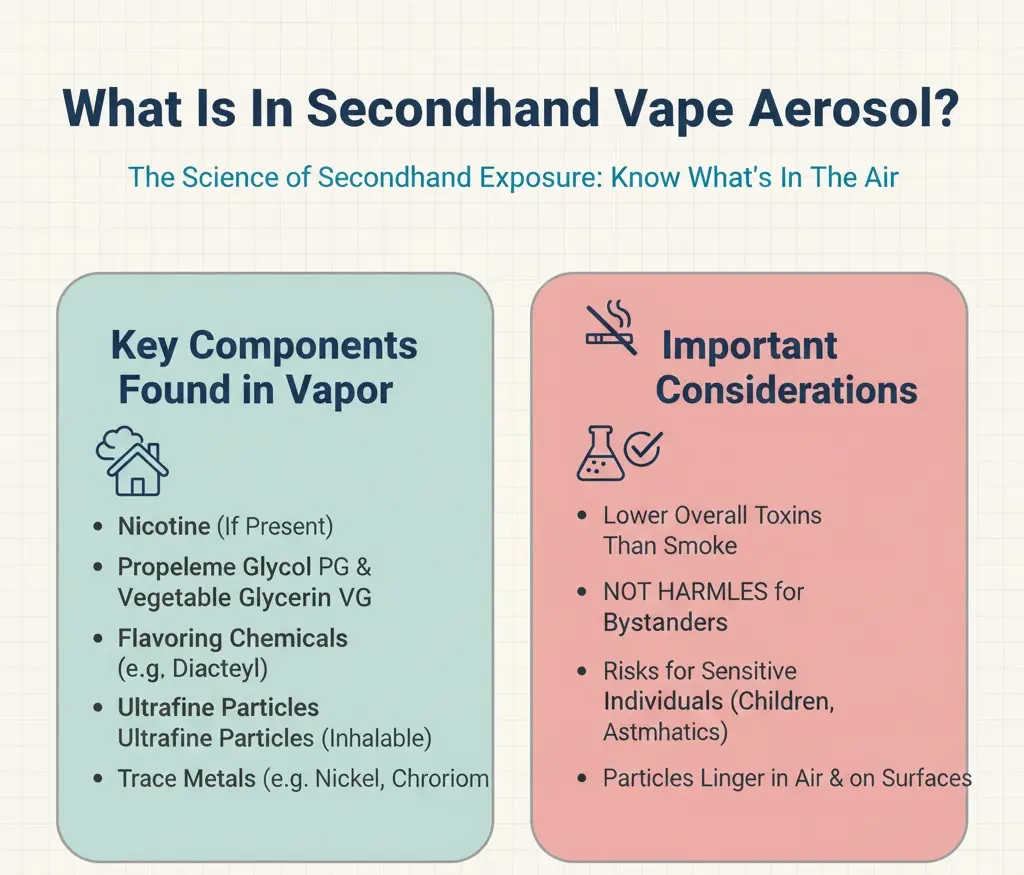
Scientific studies show that secondhand vape aerosol can contain a mixture of substances, including:
- Nicotine (if the device contains nicotine)
- Propylene glycol (PG) and vegetable glycerin (VG), which form the aerosol base
- Flavoring chemicals
- Ultrafine particles that can be inhaled deep into the lungs
- Trace metals, such as nickel or chromium, originating from heating components
While the overall chemical load is generally lower than cigarette smoke, these substances are not completely harmless—particularly for sensitive individuals.
Is Second-Hand Vape Smoke Harmful?
This is one of the most common questions, and the most honest answer is: secondhand vaping is not harmless, but it is generally less harmful than secondhand cigarette smoke.
What Research Currently Shows
Current research suggests:
- Secondhand vape aerosols contain fewer toxic chemicals than cigarette smoke.
- However, it still exposes bystanders to nicotine and other airborne substances.
- Long-term health effects are not fully understood, as widespread vaping is relatively recent.
Health agencies emphasize caution because the absence of long-term data does not equal the absence of risk.
Who May Be More Sensitive to Secondhand Vape Exposure
Certain groups may be more vulnerable, including:
- Children, whose lungs and brains are still developing
- Pregnant individuals, due to concerns about nicotine exposure concerns
- People with asthma or respiratory conditions
- Elderly individuals
- Pets, especially birds and small animals with sensitive respiratory systems
For these groups, minimizing indoor exposure is strongly advised.
Can You Absorb Nicotine From a Secondhand Vape?
Yes—nicotine can be absorbed from secondhand vape aerosol, but the amount is typically much lower than from active vaping or secondhand cigarette smoke.
How Nicotine Exposure Works
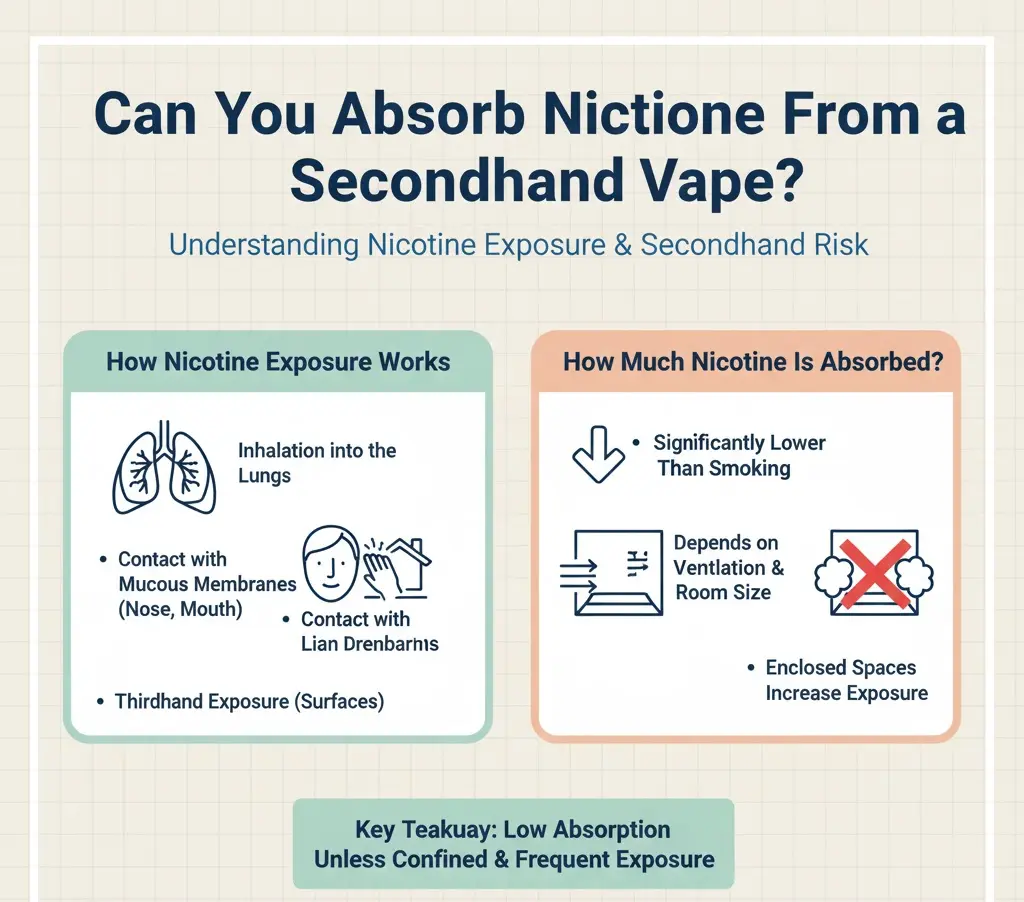
Nicotine in secondhand aerosols can enter the body through:
- Inhalation into the lungs
- Contact with mucous membranes (nose, mouth)
- Settling on surfaces and later contact (a concept sometimes called “thirdhand exposure”)
How Much Nicotine Is Absorbed?
Research indicates that:
- Nicotine levels in indoor air from vaping are significantly lower than from smoking.
- Absorption depends on ventilation, room size, and frequency of use.
- Enclosed, poorly ventilated spaces increase exposure.
In short, you can absorb nicotine from secondhand vaping, but the exposure level is usually low unless the environment is confined and exposure is frequent.
Is Vaping Inside Bad for the House?
Beyond health concerns, many people wonder whether vaping indoors affects their home. While vaping does not produce ash or heavy smoke residue, it can still impact indoor environments over time.
Does Vape Residue Stick to Surfaces?
Yes, to a limited extent. Vape aerosol can leave behind a thin, often invisible film on:
- Walls and ceilings
- Furniture
- Curtains and fabrics
- Electronics and screens
This residue is usually far lighter than cigarette smoke residue, but it can accumulate with frequent indoor vaping.
Odor and Long-Term Buildup
- Vape odors tend to dissipate faster than cigarette smoke.
- Strongly flavored e-liquids may linger temporarily.
- Over time, repeated indoor vaping can contribute to subtle surface buildup, especially in poorly ventilated areas.
This buildup is sometimes referred to as thirdhand exposure, meaning residue that remains after the aerosol has cleared.
Secondhand Vaping vs Secondhand Smoking
It’s important to distinguish between these two exposures.
| Aspect | Secondhand Vaping | Secondhand Smoking |
| Combustion | No | Yes |
| Chemical count | Lower | Very high |
| Nicotine exposure | Lower | High |
| Odor persistence | Short-term | Long-lasting |
| Surface residue | Light | Heavy |
| Long-term data | Limited | Extensive |
While secondhand vaping is widely considered less harmful than secondhand smoking, it is not considered safe for everyone in all situations.
How to Reduce Secondhand Vape Exposure Indoors
If vaping occurs in shared spaces, the following steps can reduce exposure:
- Ventilation: Open windows or use exhaust fans.
- Designated areas: Keep vaping away from children’s rooms and common living spaces.
- Air circulation: Use fans to move air outdoors.
- House rules: Set clear boundaries in shared households.
- Frequency awareness: Reducing frequency indoors reduces buildup.
No indoor solution fully eliminates exposure, but these steps significantly lower the risk.
What Health Agencies Say About Secondhand Vaping
Public health organizations generally agree on the following points:
- Secondhand vaping is not harmless.
- Exposure levels are lower than cigarette smoke, but still present.
- Vulnerable populations should avoid exposure.
- More long-term research is needed.
This cautious stance reflects responsible public health guidance rather than alarmism.
FAQ – Secondhand Vaping
Is second-hand vape smoke harmful?
It is generally less harmful than cigarette smoke, but it is not harmless, especially with repeated indoor exposure.
Can you absorb nicotine from a secondhand vape?
Yes, but usually in much smaller amounts than active vaping or secondhand smoking.
Is vaping inside bad for the house?
Vaping can leave light residue and temporary odors, especially with frequent use and poor ventilation.
Is secondhand vaping safe around children?
Health authorities recommend avoiding exposure around children whenever possible.
Does vape aerosol linger in rooms?
It dissipates faster than smoke, but residues can accumulate over time indoors.
See more
How to Fix a Disposable Vape That Won’t Hit
What Disposable Vape Lasts the Longest?
How to Use a Disposable Vape Pen with a Button: A Beginner’s Step-by-Step Guide