
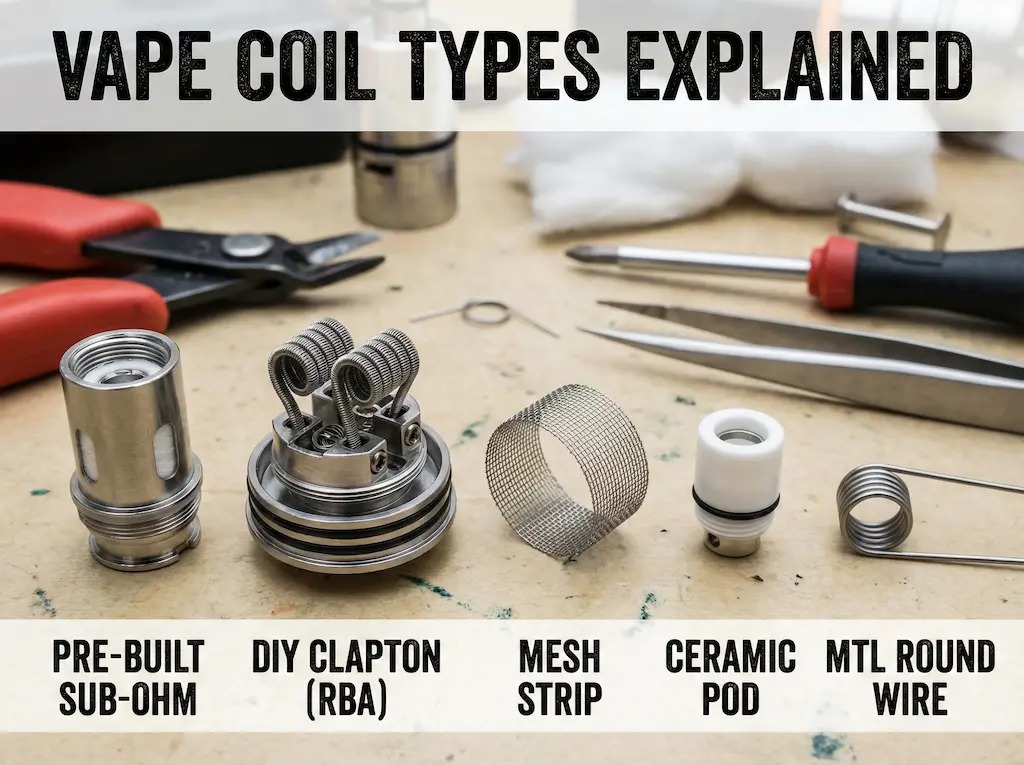
Understanding Coil Resistance, Performance, and How to Choose the Right Coil
When people talk about vaping, most conversations focus on flavors, nicotine strength, or device brands. However, one of the most important components in any vape device is often overlooked: the coil.
The vape coil is responsible for heating e-liquid and turning it into vapor. It directly affects flavor intensity, throat hit, vapor production, nicotine delivery, battery life, and even how satisfying a vape feels overall. Understanding different vape coil types and resistance levels can dramatically improve your vaping experience and help you avoid common problems like burnt taste, weak flavor, or harsh hits.
This guide explains what vape coils are, the different types available, how coil resistance (ohms) works, and how to choose the right coil for your vaping style.
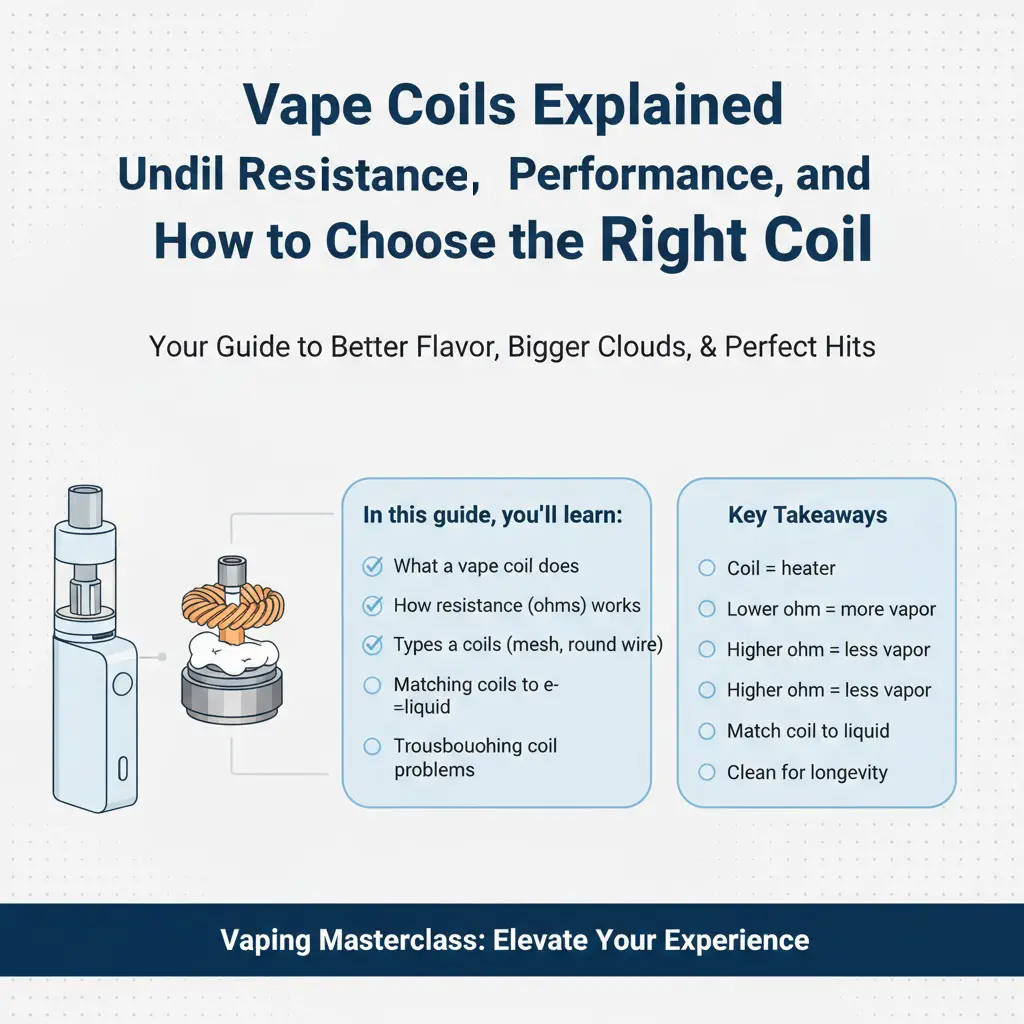
What Are the Different Types of Vape Coils?
A Detailed Breakdown of How Coil Design Affects Flavor, Vapor, and Efficiency
Vape coils may look small, but their internal structure plays a major role in how a vape performs. Different coil designs change how heat is distributed, how e-liquid is vaporized, and how consistently flavor is delivered over time.
Below is a detailed explanation of the most common vape coil types and why each exists.
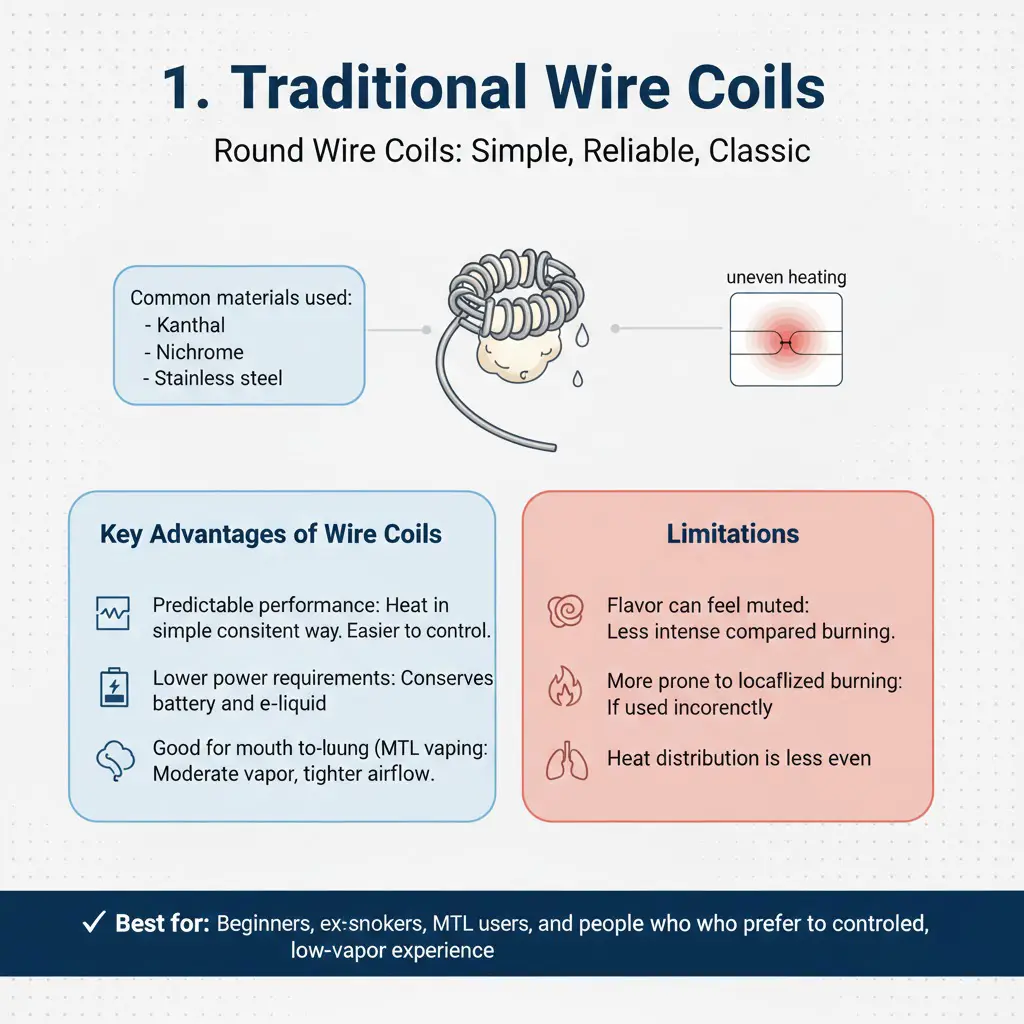
1. Traditional Wire Coils (Round Wire Coils)
Traditional wire coils are the earliest and most widely used coil design in vaping. They are made by wrapping a single strand of metal wire into a spiral shape, with cotton placed inside or around the coil to absorb e-liquid.
Common materials used:
- Kanthal – stable, easy to control, widely used
- Nichrome – heats faster than Kanthal
- Stainless steel – versatile, can be used in temperature control
How wire coils work (why they behave the way they do)
Because wire coils use a single, round wire:
- The heating surface area is relatively limited
- Heat concentrates on specific contact points
- E-liquid vaporization happens in smaller zones
This explains why wire coils tend to heat more slowly and produce less intense flavor compared to newer designs.
Key advantages of wire coils
- Predictable performance
Wire coils heat in a simple, consistent way. This makes them easier for beginners to control and less likely to cause sudden overheating. - Lower power requirements
Many wire coils operate efficiently at low wattages, which helps conserve battery life and e-liquid. - Good for mouth-to-lung (MTL) vaping
Their moderate vapor output and tighter airflow closely resemble cigarette-style inhalation.
Limitations
- Flavor can feel muted compared to mesh coils
- Heat distribution is less even
- More prone to localized burning if used incorrectly
Best for: Beginners, ex-smokers, MTL users, and people who prefer a controlled, low-vapor experience.
2. Mesh Coils
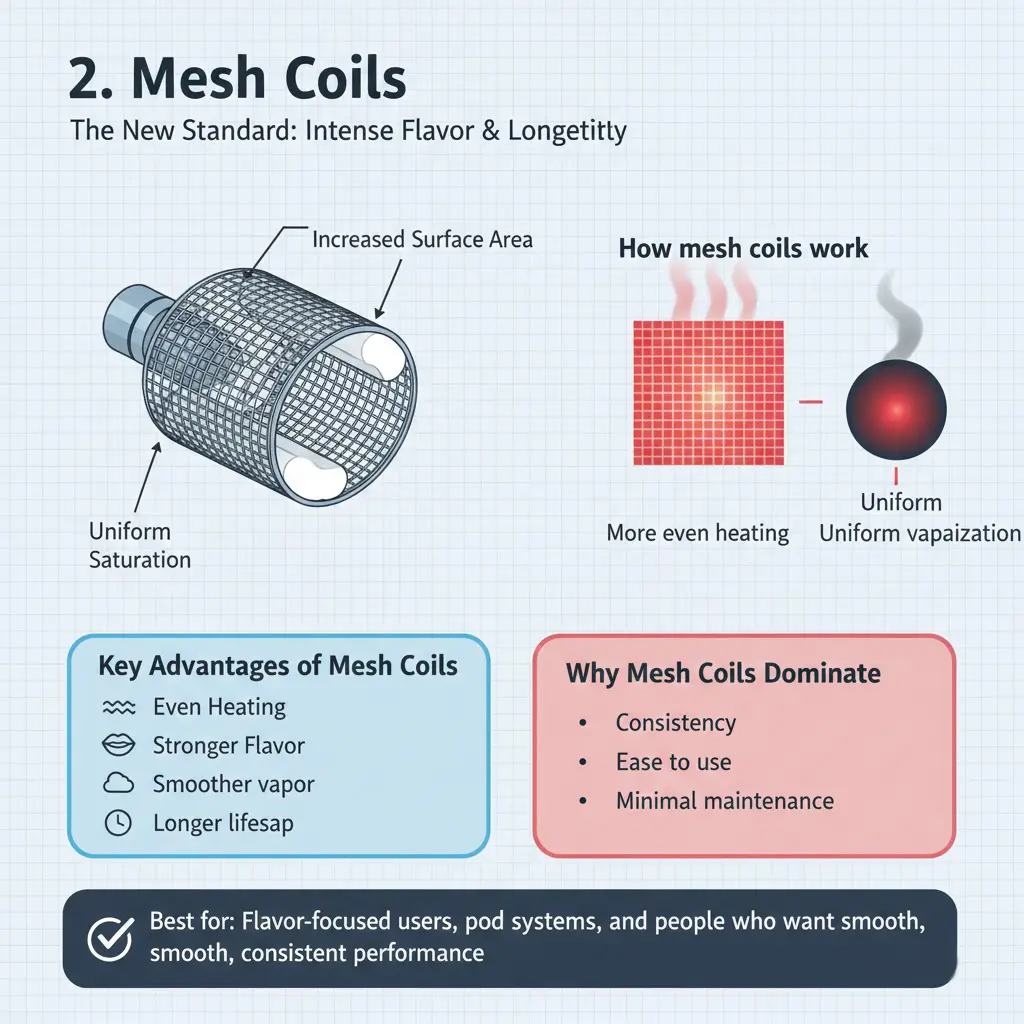
Mesh coils represent one of the biggest advancements in vape coil technology. Instead of a round wire, mesh coils use a thin sheet or grid of metal with many small openings.
Why mesh coils perform differently
The mesh structure dramatically increases surface area. Instead of heat being concentrated in a few spots, it spreads evenly across the entire mesh.
This leads to:
- Faster heat-up time
- More uniform vaporization
- Less stress on any single section of the wick
Key advantages of mesh coils
More even heating
Because heat is distributed across a wide surface, mesh coils reduce hot spots that cause burnt flavor.
Stronger and more consistent flavor
More e-liquid is vaporized at once, producing fuller flavor with better detail and balance.
Smoother vapor production
Even heating prevents harsh temperature spikes, making inhalation smoother.
Longer coil lifespan
Reduced localized burning means cotton lasts longer and flavor stays stable for more puffs.
Why mesh coils dominate pod systems and disposable vapes
Disposable vapes and pod systems prioritize:
- Consistency
- Ease of use
- Minimal maintenance
Mesh coils meet these goals by delivering reliable performance without user adjustments, which is why they are now the industry standard in disposables.
Best for: Flavor-focused users, disposable vape users, pod systems, and people who want smooth, consistent performance.
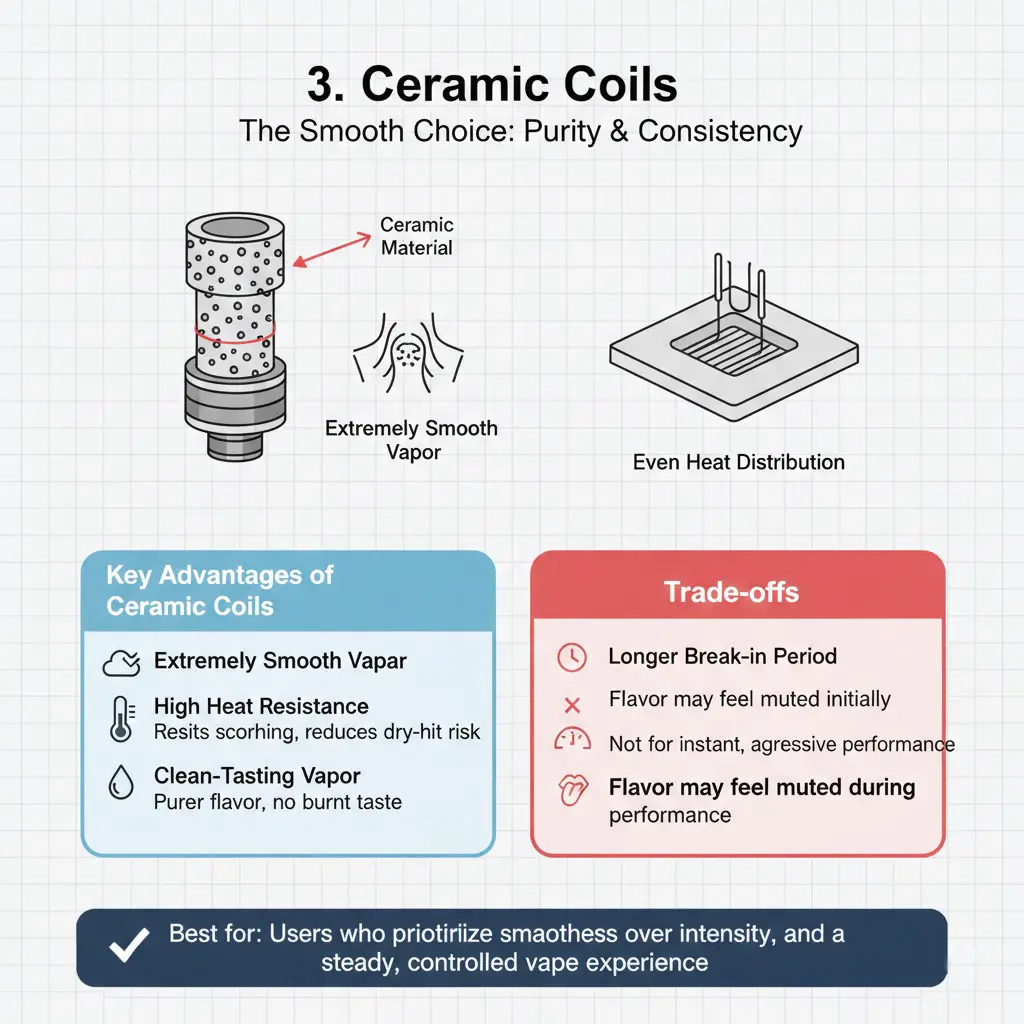
3. Ceramic Coils
Ceramic coils use porous ceramic material either as the heating surface or as part of the wick system. Instead of relying solely on cotton, ceramic absorbs e-liquid through microscopic pores.
How ceramic coils behave differently
Ceramic materials:
- Absorb liquid more slowly
- Retain heat more evenly
- Resists scorching better than cotton
This creates a different vaporization profile compared to wire or mesh coils.
Key advantages of ceramic coils
Extremely smooth vapor
Ceramic produces softer, less aggressive vapor, which some users find gentler on the throat.
High heat resistance
Ceramic tolerates high temperatures without burning, reducing dry-hit risk.
Clean-tasting vapor
Many users describe ceramic vapor as “cleaner” or “purer,” especially with subtle flavors.
Trade-offs
- Longer break-in period
- Flavor may feel muted during early use
- Slower response compared to mesh
Ceramic coils are not designed for instant performance but for stability over time.
Best for: Users who prioritize smoothness over intensity and prefer a steady, controlled vape experience.
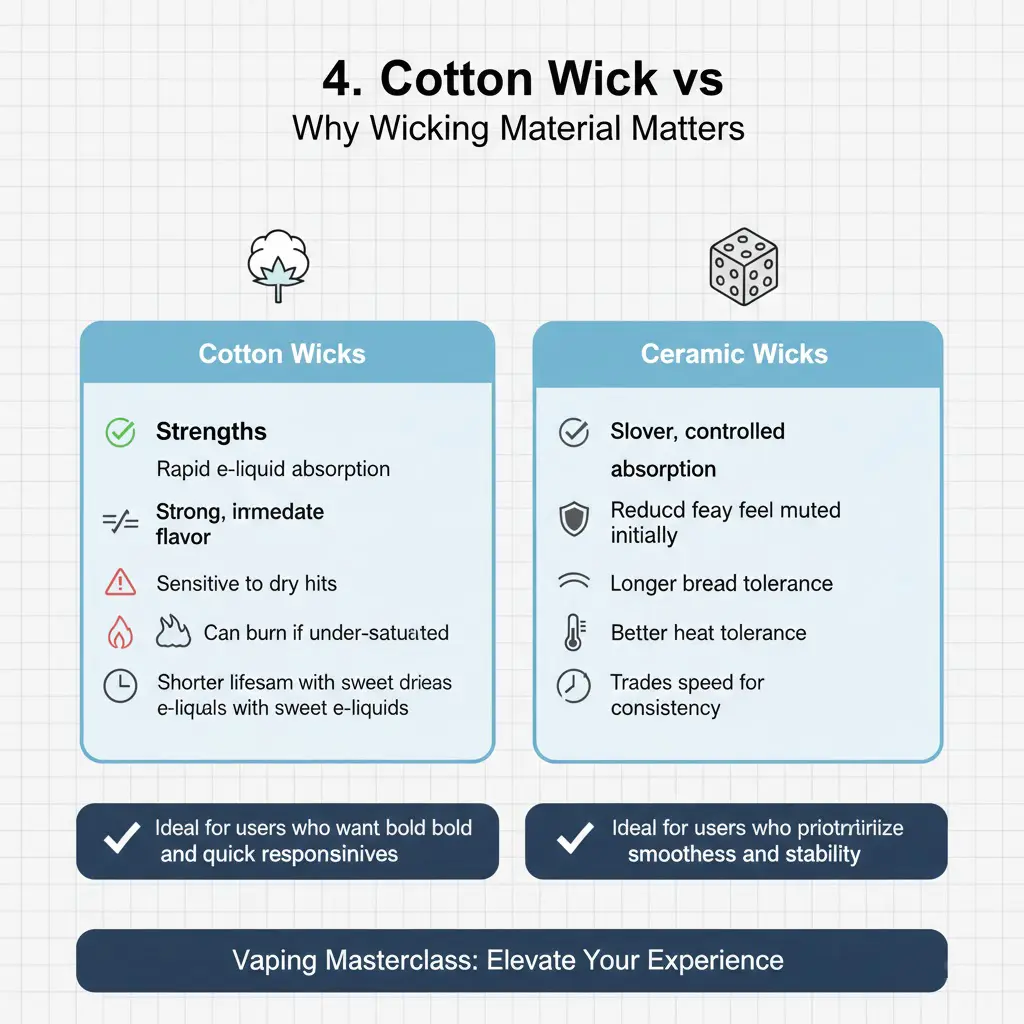
4. Cotton Wick vs Ceramic Wick (Why Wicking Material Matters)
The wick is responsible for delivering e-liquid to the heating element. Even with the same coil design, wick material can significantly change performance.
Cotton Wicks
Strengths:
- Rapid e-liquid absorption
- Strong, immediate flavor
- Short break-in time
Weaknesses:
- More sensitive to dry hits
- Can burn if under-saturated
- Shorter lifespan with sweet e-liquids
Cotton is ideal for users who want bold flavor and quick responsiveness.
Ceramic Wicks
Strengths:
- Slower, controlled absorption
- Reduced dry-hit risk
- Better heat tolerance
Weaknesses:
- Longer break-in
- Slightly softer flavor delivery
Ceramic wicks trade speed for consistency and smoothness.
Cotton vs Ceramic Wick Comparison
| Feature | Cotton Wick | Ceramic Wick |
| Absorption speed | Fast | Slower |
| Flavor intensity | Strong | Smooth |
| Dry hit risk | Higher | Lower |
| Heat tolerance | Moderate | High |
| Break-in time | Short | Longer |
Why This Section Matters
Understanding coil types is not just technical knowledge—it. It directly affects:
- Flavor satisfaction
- Throat comfort
- Battery efficiency
- Coil lifespan
- Overall enjoyment
This is why coil selection is one of the most important decisions a vaper makes.
Understanding Coil Resistance (Ohms) in Simple Terms
Coil resistance is measured in ohms (Ω) and refers to how much the coil resists electrical current.
A simple rule to remember:
- Lower resistance = more power
- Higher resistance = less power
Resistance affects:
- Vapor volume
- Nicotine delivery speed
- Battery consumption
- E-liquid usage
Resistance Categories
Sub-ohm coils (below 1.0Ω)
- Higher power
- More vapor
- Best for lower nicotine levels
High-resistance coils (1.0Ω and above)
- Lower power
- Less vapor
- Better for nicotine salts and MTL vaping
Is a 1.2 or 0.8 Coil Better?
This is one of the most frequently asked questions in vaping, and the answer depends entirely on your preferences.
0.8 Ohm Coil
A 0.8Ω coil sits in the middle ground between sub-ohm and high-resistance vaping.
What to expect:
- Moderate vapor production
- Stronger flavor
- Slightly looser airflow
- Smoother throat hit
Best suited for:
- Restricted direct lung (RDL) users
- Lower nicotine strengths
- Users who want balanced performance
1.2 Ohm Coil
A 1.2Ω coil is designed for low-power, cigarette-like vaping.
What to expect:
- Less vapor
- Clean, focused flavor
- Sharper throat hit
- Tight airflow
Best suited for:
- Mouth-to-lung (MTL) users
- Nicotine salt e-liquids
- Former smokers
0.8 vs 1.2 Ohm Comparison
| Feature | 0.8Ω Coil | 1.2Ω Coil |
| Vapor production | Medium | Low |
| Flavor intensity | Strong | Clean |
| Throat hit | Smooth | Sharper |
| Airflow | Looser | Tighter |
| Nicotine type | Freebase / low nic | Nic salts |
| Battery efficiency | Moderate | High |
How to Know Which Coil to Use for a Vape
Choosing the right coil is easier if you focus on how you vape rather than technical specs.
Ask Yourself These Questions
- Do I want more vapor or more control?
- Do I prefer tight or airy airflow?
- What nicotine strength do I use?
- How large is my device’s battery?
Coil Choice by Vaping Style
| Vaping Style | Recommended Coil |
| Mouth-to-lung (MTL) | 1.0–1.2Ω |
| Restricted direct lung (RDL) | 0.6–0.8Ω |
| Direct lung (DTL) | Below 0.5Ω |
Coil Choice by Nicotine Type
- Nicotine salts → higher resistance
- Freebase nicotine → lower resistance
Using a low-resistance coil with high nicotine can feel harsh and overwhelming.
Common Mistakes When Choosing Vape Coils
Many vaping issues come from mismatched coil choices.
Frequent mistakes include:
- Using high nicotine with sub-ohm coils
- Expecting a cigarette-like throat hit from low resistance
- Ignoring recommended wattage ranges
- Not allowing coils to break in properly
Correct coil selection prevents burnt taste, throat irritation, and wasted e-liquid.
If you’re more focused on maintenance, you can also read our step-by-step guide on mesh coil benefits and how to replace a vape coil.
How Coil Choice Affects Flavor, Throat Hit, and Battery Life
Flavor
- Mesh coils enhance flavor clarity
- Higher resistance delivers cleaner, sharper flavor notes
Throat Hit
- Higher resistance produces a stronger throat hit
- Lower resistance smooths out the inhale
Battery Life
- Higher resistance coils use less power
- Lower resistance coils drain batteries faster
Final Thoughts: There Is No “Best” Vape Coil
There is no universal “best” vape coil. The right coil depends on:
- Your inhalation style
- Nicotine preference
- Desired vapor level
- Device capability
Understanding coil types and resistance helps you make informed choices and get the most out of your vape.
FAQ
Is a higher ohm better for beginners?
Yes. Higher resistance coils offer smoother control and are easier to manage.
Do mesh coils last longer?
In most cases, yes. Mesh heats evenly and reduces localized burning.
Why does my coil burn quickly?
Using excessive power, high-sweetener liquids, or insufficient break-in can shorten coil life.
Can I switch coil resistance freely?
Only if your device supports the coil and wattage range.
Does coil resistance affect nicotine absorption?
Yes. Lower resistance delivers nicotine faster and more intensely.
You Can Read More
How to Do Vape Tricks (Step-by-Step Guide for Beginners)
How to Inhale a Vape: Learn the Proper Way to Vape Safely and Smoothly