
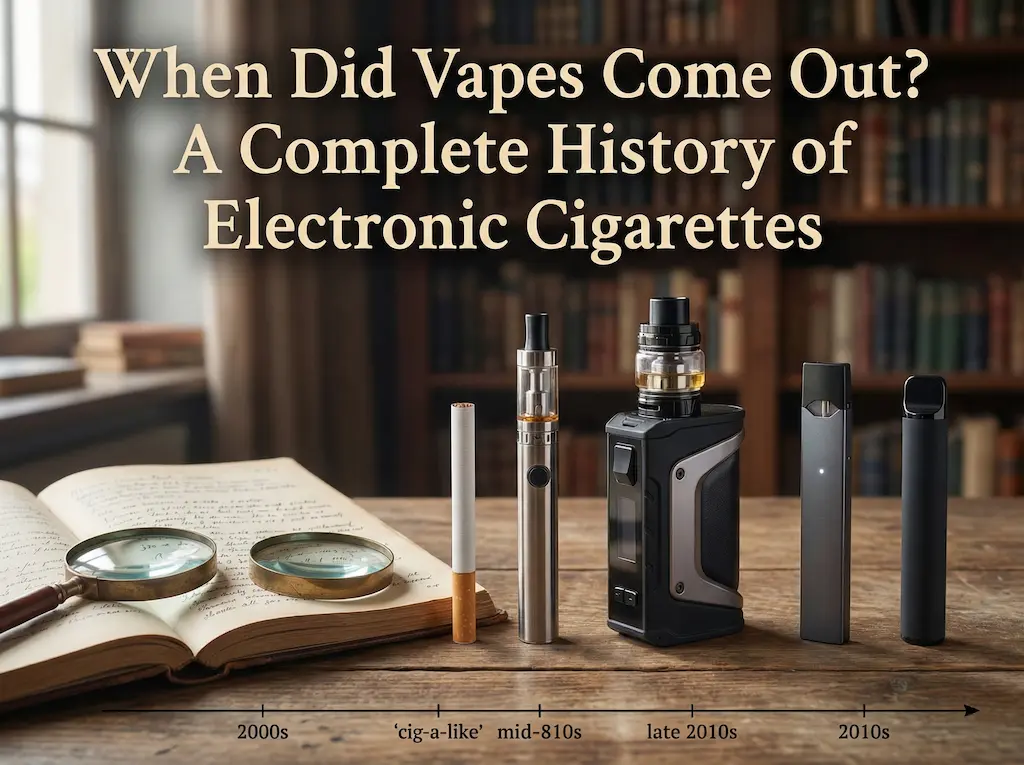
A Clear Timeline of the History of Electronic Cigarettes
Many people assume that vaping is a recent trend, something that suddenly appeared within the last decade. Others remember seeing early electronic cigarettes years ago, but are unsure when they actually became available. Questions like “When did vapes come out?”, “Were vapes a thing in the 2000s?”, “Were vapes around in 2007?” and “When did JUUL come out?” are searched millions of times every year.
The confusion comes from the fact that electronic cigarettes did not appear all at once in their modern form. Instead, vaping technology evolved gradually—moving from early experimental devices to mass-market products over more than two decades.
This article provides a clear, factual timeline of vaping history, explaining when vapes were first invented, when they entered the market, how they evolved through the 2000s, and why certain milestones—like the launch of JUUL—changed the industry so dramatically.
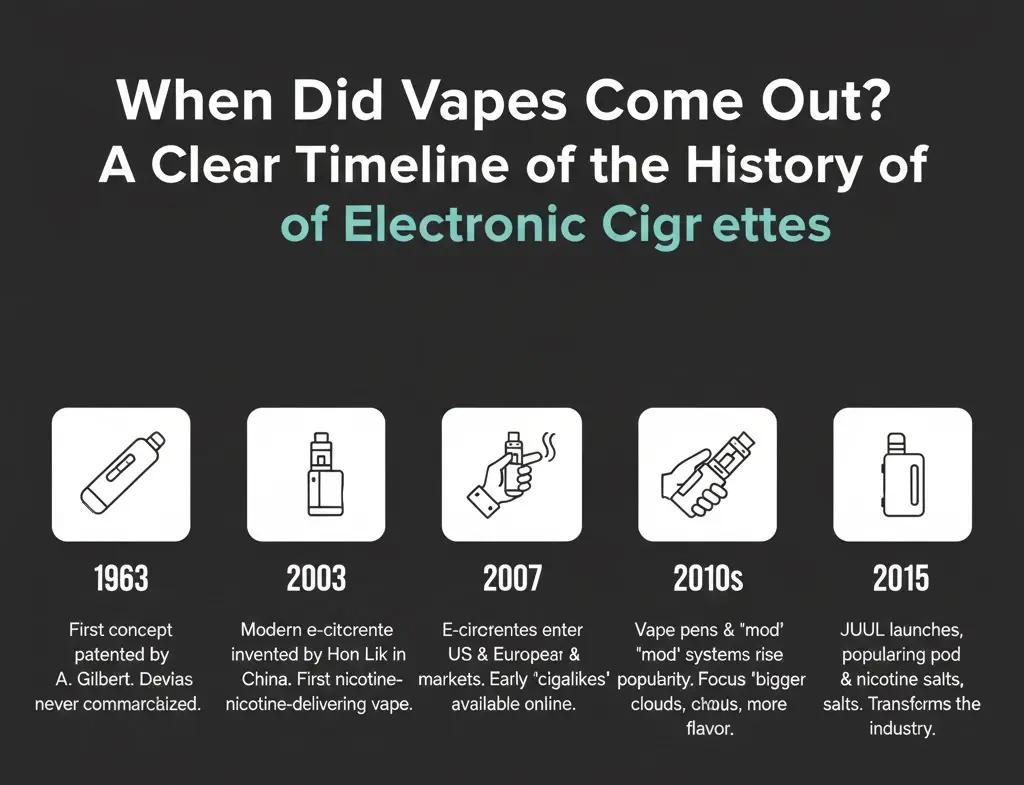
What Is Considered the First Vape?
Before discussing dates, it’s important to define what people mean by “vape.” In modern terms, a vape is a battery-powered device that heats a liquid to create an inhalable aerosol without combustion. This distinguishes vaping from smoking, which relies on burning tobacco.
Early Concepts Before Modern Vaping
Ideas for smokeless nicotine delivery existed long before modern electronic cigarettes. As early as the 1960s, inventors experimented with devices designed to deliver nicotine vapor instead of smoke. However, these early concepts never achieved commercial success. They lacked efficient batteries, reliable heating systems, and consistent aerosol production.
As a result, they are generally not considered true predecessors of today’s vapes.
Hon Lik and the First Modern Electronic Cigarette (2003)
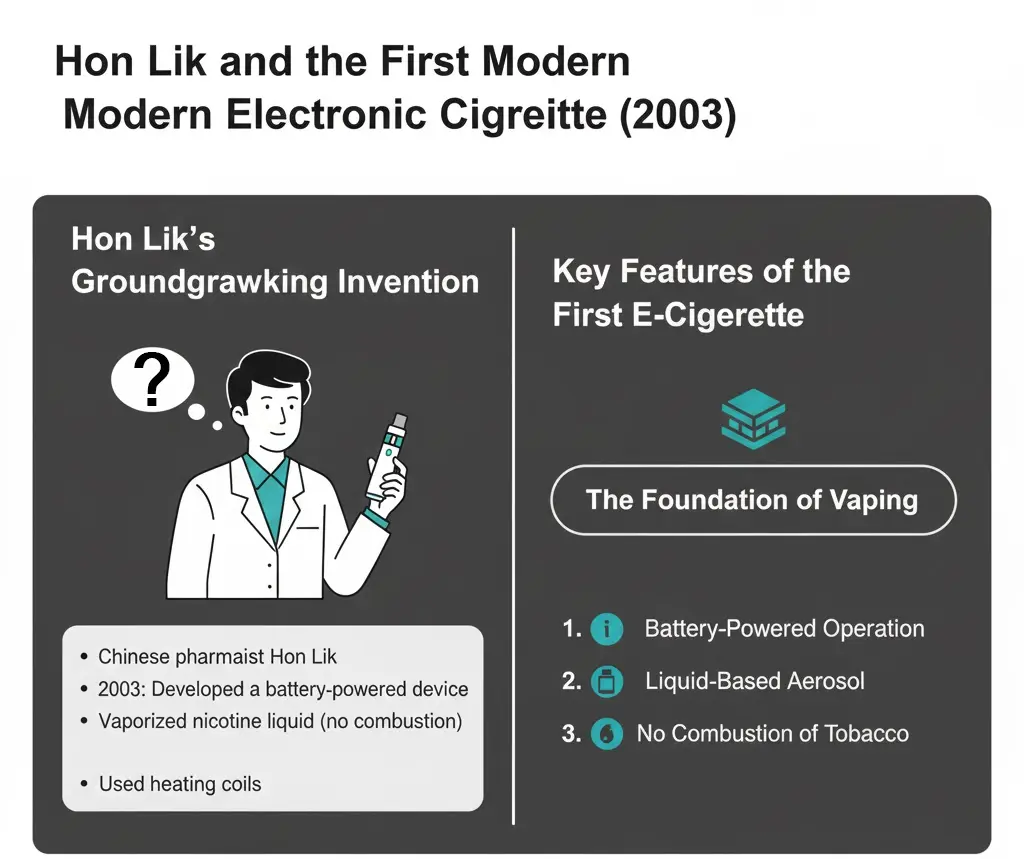
The modern electronic cigarette is widely credited to Hon Lik, a Chinese pharmacist. In 2003, Hon Lik developed a battery-powered device that vaporized a nicotine-containing liquid using ultrasonic technology and later heating coils.
This invention is widely recognized as the first true electronic cigarette because it combined:
- Battery-powered operation
- Liquid-based aerosol generation
- No combustion of tobacco
According to historical records compiled by organizations such as CASAA (Consumer Advocates for Smoke-free Alternatives Association), this 2003 invention marks the beginning of modern vaping.
Were Vapes a Thing in the 2000s?
The short answer is yes—but not in the way people think of vaping today.
Early 2000s: Invention Without Public Awareness
Between 2003 and 2005, electronic cigarettes existed primarily as a new invention rather than a consumer trend. Production was limited, and awareness outside of China was extremely low. Most smokers in North America and Europe had never heard of electronic cigarettes during this period.
Devices were not widely advertised, and there was no established vape culture.
Mid-to-Late 2000s: Early Commercial Availability
By 2006–2007, electronic cigarettes began appearing in international markets. Small distributors introduced them in parts of Europe and North America, often through online sales or specialty shops.
These early vapes were typically:
- Small and cigarette-shaped (often called “cigalikes”)
- Low-powered with small batteries
- Limited in vapor production and flavor options
Although they existed, they were niche products with very limited adoption.
Were Vapes Around in 2007?
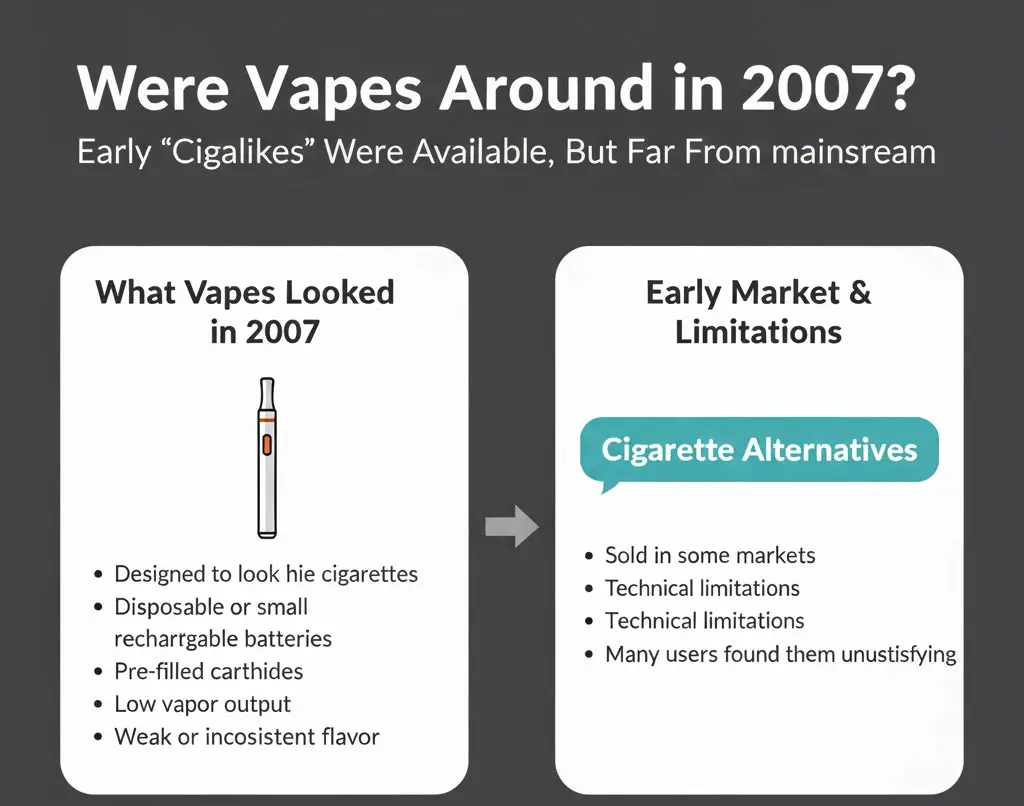
Yes—vapes were around in 2007, but they were far from mainstream.
In 2007, electronic cigarettes were already being sold in some markets, but they looked and performed very differently from modern devices. Most were designed to resemble traditional cigarettes as closely as possible, both in appearance and usage.
What Vapes Looked Like in 2007
Typical characteristics of 2007-era vapes included:
- Disposable or very small rechargeable batteries
- Pre-filled cartridges
- Low vapor output
- Weak or inconsistent flavor
These devices were often marketed as cigarette alternatives, but many users found them unsatisfying due to technical limitations.
Why Early Vapes Did Not Become Popular Immediately
Despite existing in the 2000s, vapes did not become widely popular until years later. Several factors contributed to this slow adoption.
Battery technology was one of the biggest limitations. Early lithium batteries were small and inefficient, leading to short usage times and weak heating performance. Atomizer technology was also underdeveloped, producing inconsistent vapor and flavor.
In addition, there was little public awareness, limited retail distribution, and no strong online vaping community. Without social media, review platforms, or influencer culture, vaping remained largely invisible to the average consumer.
When Did Vapes Become More Common?
Vaping began to gain traction in the early 2010s as technology improved.
2010–2013: Second-Generation Devices
During this period, second-generation e-cigarettes entered the market. These devices featured:
- Larger rechargeable batteries
- Refillable tanks
- Replaceable coils
Often referred to as eGo-style devices, they delivered better vapor production and longer battery life. This marked the first time many users felt that vaping could be a practical alternative to smoking.
2014–2016: Expansion of Vape Culture
Between 2014 and 2016, vaping technology advanced rapidly. Box mods, adjustable power settings, and sub-ohm coils allowed users to customize their experience. Flavor variety expanded significantly, and vaping communities grew online.
At this stage, vaping became more than just a smoking alternative—it became a distinct product category.
When Did JUUL Come Out?
One of the most searched questions about vaping history is “When did JUUL come out?”
JUUL Labs was founded in 2015, and its first product entered the U.S. market shortly afterward, gaining significant traction around 2016.
Why JUUL Changed the Vape Market
JUUL introduced several innovations that reshaped vaping:
- Nicotine salt formulations that allow higher nicotine delivery with less throat irritation
- A compact, USB-shaped design
- Simple, draw-activated operation
These changes made vaping more accessible to users who found earlier devices too complex or unsatisfying.
How JUUL Differed from Earlier Vapes
Unlike earlier refillable systems, JUUL focused on ease of use and consistency. It did not require manual power adjustments or coil changes. This simplicity helped pod systems become one of the most dominant formats in the vaping industry.
How Long Have Vapes Been Around in Total?
If we measure from the invention of the modern electronic cigarette in 2003, vaping has existed for over 20 years. If we measure from widespread public adoption, vaping has been common for roughly 10–15 years.
The perception that vaping is “new” comes from how quickly technology evolved in a relatively short period.
A Simple Vape History Timeline
| Year | Milestone |
| 2003 | The first modern electronic cigarette was invented |
| 2006–2007 | Early commercial availability |
| 2010 | Second-generation refillable devices |
| 2014 | Expansion of advanced vape mods |
| 2015–2016 | JUUL enters the market |
| 2018+ | Pod systems and disposables grow |
Why Understanding Vape History Matters
Understanding when vapes came out helps clarify common misconceptions. Vaping is not a sudden phenomenon, nor is it experimental technology. It has undergone decades of refinement, driven by improvements in batteries, materials, and engineering.
This context also explains why early experiences with vaping varied so widely and why modern devices feel dramatically different from those of the 2000s.
Conclusion: Vaping Is Not New—But It Has Evolved Rapidly
Electronic cigarettes first appeared in the early 2000s, entered limited markets by 2007, and gradually evolved into the diverse ecosystem seen today. While vaping may feel like a modern invention, it is the result of more than two decades of technological development.
From early cigalikes to pod systems and disposables, vaping’s history is defined by continuous innovation rather than sudden emergence.
FAQ – Vape History Questions
When did vapes first come out?
Modern electronic cigarettes were invented in 2003.
Were vapes a thing in the 2000s?
Yes, but they were niche products with limited availability and awareness.
Were vapes around in 2007?
Yes, early electronic cigarettes were sold in 2007, mainly in cigalike form.
When did JUUL come out?
JUUL entered the market around 2015–2016.
How long have electronic cigarettes existed?
For over 20 years, widespread adoption has occurred later.
You Can Read More
How to Pick the Best Electronic Cigarette for Your Needs